
by Maya Thomas
Matt shared updates from his creative life, including serving on the masthead at confluence haiku. In case you missed it, we featured confluence haiku in the April eMuse because they are accepting submissions until May 1 for their prize for best haikus centered on the themes of death and dying. Intern Maya Thomas asked Matt about the forces shaping his haiku writing practice and the impetus for his Poetry in Plain Sight Poem, “graceful bow”.
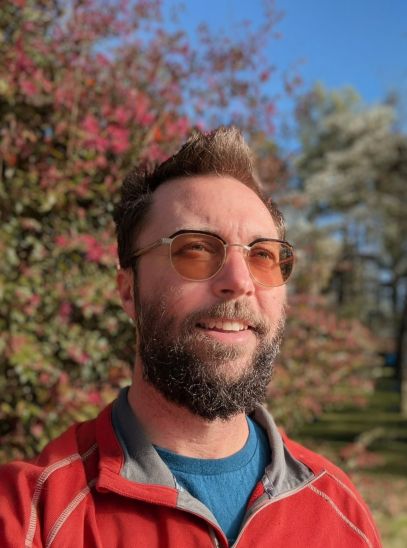
Matt Snyder is a gardener, runner, poet, uncle, living in NC by way of D. C. from IN. When he isn’t trying the garden, keeping his ducks and dog entertained, or playing Minecraft with his nephews, he writes (and sometimes while doing those things, too). A happy accident led him to haiku and groups like the Towpath and NC Haiku societies, and his work has appeared in numerous journals and anthologies. Writing haiku helps Matt to be present, observant, and appreciative. Read more at pittsboropinepress.com.
How did you become interested in haiku, and when did you begin writing haiku?
In 2010, I was running a community newsletter with a friend, and one our submitters jokingly sent in some 5-7-5 haiku-ish poems. The tone of our publication was fairly tongue-in-cheek, so I decided I would read an authoritative source on haiku, and write a serious, critical response in the next issue. This brought me to reading “The Narrow Road to the Deep North” by Matsuo Basho, the father of haiku. I loved it; I couldn’t get enough. I never did write that article for the newsletter, but haiku and related forms have been a part of my life ever since.
I wrote my first haiku in 2017. I’d been reading haiku for several years by that time, and I think I had a vague sense of “imposter syndrome” telling me that as much as I enjoyed reading haiku, I wouldn’t be able to write. But after a good long run, feeling mentally empty and physically satisfied, I gave in. I wrote off and on for a few years, basically just responding to what I read from the old masters. Frankly it hadn’t occurred to me that people were still writing haiku, I thought this was just a fun little side hobby. During the pandemic, by luck I heard about and attended the Haiku Society of America’s virtual conference. It was a delight to find modern community, and I have been loving it ever since.
How has writing haiku shifted your perspective as you navigate life?
Haiku mindset is a place to go when I want to observe, appreciate, de-stress, create. It’s always there, drawing my eye. In the middle of digging 20 fence post holes, a phoebe perches on my shovel. Unmoving in a jetway, the sound of rain just above our heads. The energy in Grandma’s voice when she talks about home.
The community aspect has been a big shift, too. Even five years ago, I didn’t know life would be like this — now, writing, editing, and participating in the broader community is simply central to my life.
You are on the masthead for confluence haiku. How has your experience working on a literary magazine changed your poetry?
Working on confluence haiku has been a wonderful experience. My fellow editors bring such diverse and brilliant viewpoints. Our cohort of fellows each has their own unique voice. I haven’t previously given such focus to individual poets’ voices, so this has really sharpened my sense of what makes for distinct voice, whether the choices of topic, the poetic tone, personal background, etc. The other thing it has done for my work has produced less of it 🙂 as I devote time to the editorial and community work we do.
Do you have a haiku that you would like to share? Do you have any links to publications that feature your work?
Gladly, here’s a couple. The poem “falcons” was an early one that I revised in correspondence with other poets, and “winter sun” recently received an award from the Poetry Pea.
falcons over the river
grandpa tells me
about their new home
winter sun
a bird’s shadow
lost in the tree’s
Many haiku journals are print-only, but a few links I’d like to share: Pittsboro Pine Press (my own site), Heron’s Nest 2022, Heron’s Nest 2023, Failed Haiku 2024.
One of your poems, “a graceful bow,” was featured as a part of the Poetry in Plain Sight program in 2025-2026. What was your inspiration for this poem?
This poem was written when I lived in D.C., proud of gardening my little postage stamp space. Yarrow, wood fern, river birch, pomegranate, rosemary, lavender, and more. And coneflower, of course. The seasonal changes were dramatic and fun in the small space, and the coneflower in particular I left the dried stalks all winter for the birds. It’s surprising how hard and prickly the cones are, I pricked my fingers only once! Anyway, looking out the window one day, I was first mystified by a stalk bending deeply, rising up, bending again, then delighted to realize it was a goldfinch having alighted upon the dried cone.
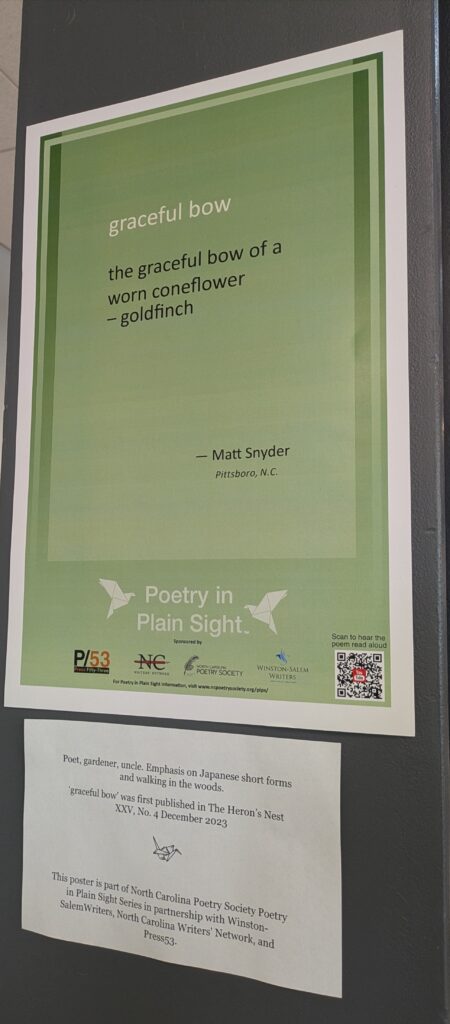
Matt’s poem “graceful bow” spotted at Cary Regional Library.
You are a runner in addition to being a poet. How has running influenced your mindset as a poet?
Running has a wonderful meditative overlap with writing. It’s a space to think, not-think, and write. I often shout poems into my phone as I go.
How have groups like Towpath and NC Haiku fueled your work?
In fact, this was the greatest fuel for my interest. In the beginning, I thought haiku was my private little side hobby. When I found thriving, modern community, I lit up. Participation in these groups gives me energy, it connects me to fellow poets and I learned from them, we do workshopping, share craft, and more. A couple of my projects I would like to share from those groups: Towpath’s Exploration of Seasons, NCHS’s My Fellow Poets.
Which poets/writers influence your work or are you interested in?
My favorite haiku is by J. Zimmerman, who sadly passed earlier this year. This poem catches in my throat and overwhelms me with immensity.
windless dawn
a marigold wreath
sways in the kelp
All the poets in my local groups teach me and inspire me. In particular Lee Giesecke, whose poems delight in lightness and wit, and Jean Earnhardt who hosts our NCHS gatherings and whose work is steeped in love and vulnerability. Early on, I learned from and was encouraged by correspondence with Robert Epstein. And I learn a lot from writing and working with Ryland Li, especially his ardor in reading aloud. I’m also grateful for correspondence with and community created by editors such as Patricia McGuire at the Poetry Pea.
Lastly, what are your future plans with poetry? Are there any upcoming events or publications that you will be a part of?
As much as I can, I’m looking forward to writing more, and creating larger collections and works. I am also excited for a haiku card-matching game that I’m working on, the upcoming confluence haiku collaborative issue is going to be big and fun, and later this year I will serve as editor the Haiku Society of America’s annual member anthology.