
by Liz Maceda
Steph took time to reflect on her lovely poems NCPS has recognized both as a Poetry in Plain Sight poster in the 2025-2026 season and in the 2024 Pinesong anthology. She shared her thoughts and inspiration behind her work with our intern Liz. Read on to experience the forest and carolina wrens from her perspective.
Steph Jeffries is a naturalist at heart and a forest ecologist by training. She loves poetry as another pathway to connect people with nature. She is a teaching professor in forestry at N.C. State University and co-author of Exploring Southern Appalachian Forests (UNC Press 2014). She recently published poems in Kakalak and Pinesong. She can be found on Instagram and Youtube.
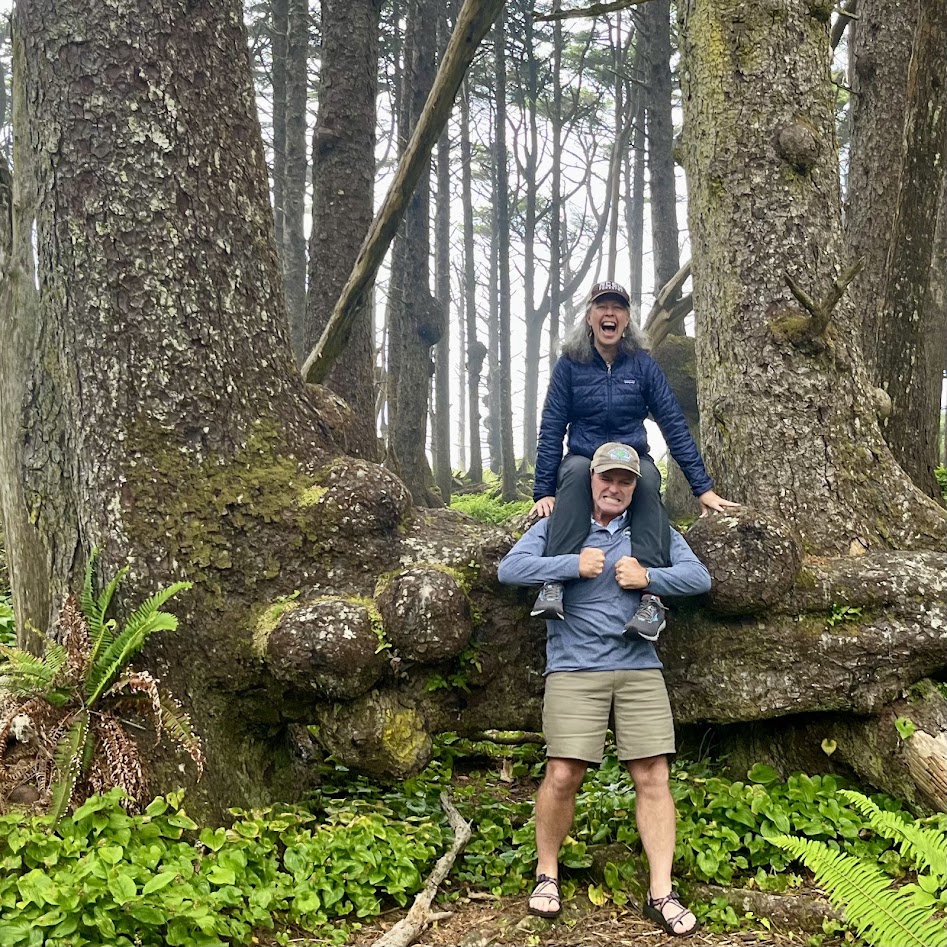
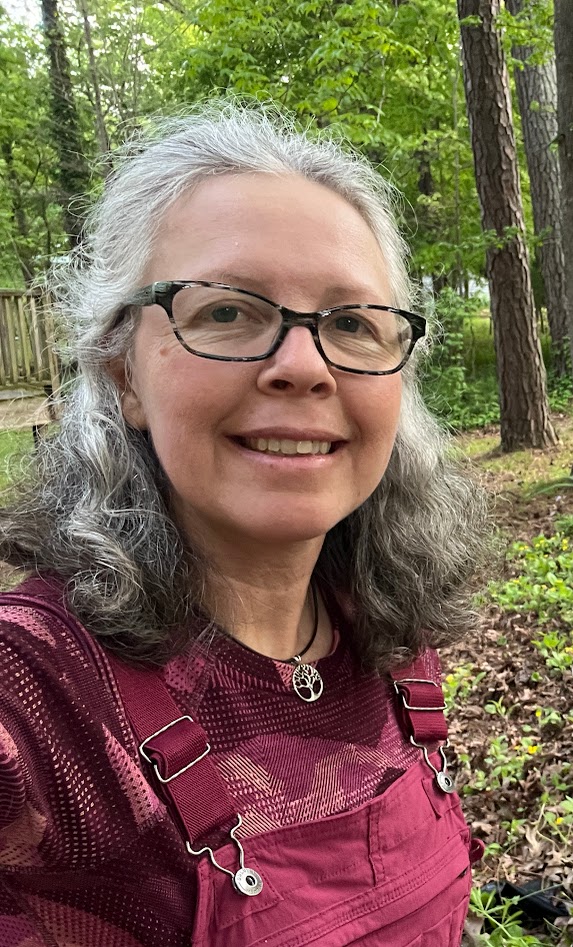
What inspired you to begin writing poetry and how did your writing career start?
I wrote poetry starting in elementary school through high school, but stepped away when I was in college, graduate school, and through the early part of my career. My work involves a lot of reading and writing, so I didn’t allocate time for creative writing until the past 10 years or so. My best friend, Ann, encouraged me and started giving me poetry collections, starting with Ten Thousand Mornings, by Mary Oliver. We went on wonderful weekend retreats to work on our respective writing. She gave me The Artist’s Way during COVID, and we both did Laurie Wagner’s Wild Writing offerings while we were cooped up. Since then, I’ve become more intentional about finding space to write poetry.
How does your work as a naturalist and forest ecologist influence your poetry?
Being a forest ecologist enables me to spend a lot of time out in nature, and I’m trained as an observer of the natural world. So while most people see beauty in forests, I often see a story, with individual trees, the landscape, topography, understory plants, threats, and what’s missing. Poetry is all about small moments and details, so my scientist’s brain can zoom in easily. But, I often struggle to not over-explain or share every detail that I see so I can step out to tell the larger story.
In your poem “Planting Hope”, nature and gardening are important images. How does your love for nature inspire the themes in your writing?
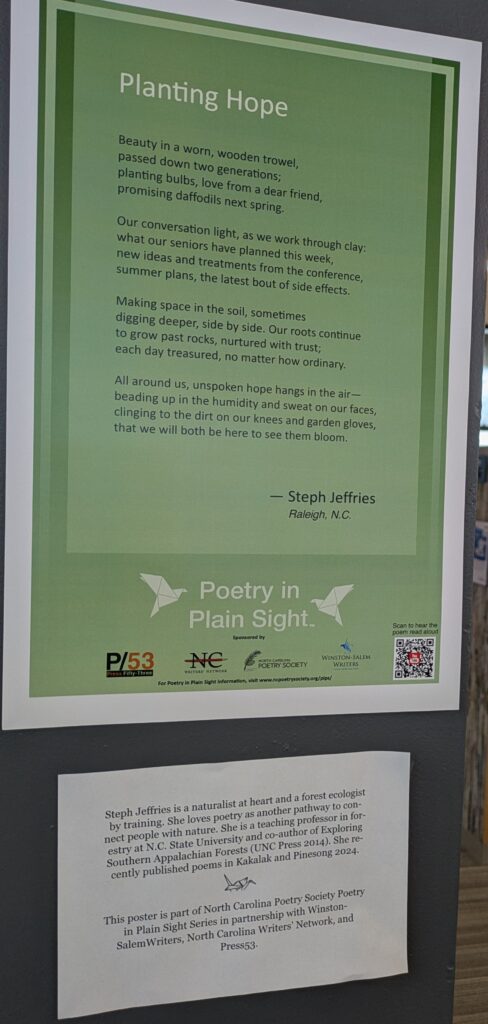
Nature inspires every aspect of my life, including my writing. This poem was about an afternoon I spent with Ann, who had stage IV cancer. She’d recently been told she would likely only have another six months. A friend had given us hundreds of daffodil bulbs when she moved. It seemed fruitless to spend time planting them; after all, she wouldn’t be here to see them flower. We resolutely planted them anyway, talking about anything but that, often silent and teary. It was a radical act of hope. Her treatments worked better than expected, and she also wrote an essay, “Faith from a Flower,” about that day the following year, when the daffodils emerged after winter. Gardening reminds you to choose hope. [Sorry, that didn’t really answer your question, but it’s the critical inspiration for that poem.]
“Planting Hope” pictured at Cary Regional Library.
Do you often use plants, gardens, or landscapes as symbols in your poems? Why?
Yes, because I can’t help it :). I write about trees, nature, and landscapes most often; I’m an enthusiastic but lousy gardener. But I also think these are relatable symbols to others, so they can open a door into the poem. There is so much we can take away from the rhythms of the natural world and apply to our own lives.
How does the outdoors help create ideas or emotions in your poetry?
Outdoors is where my ideas flow most freely. It’s my favorite place to find stillness and peace, and that’s where I do my best thinking, feeling, and then writing. I’m a distance trail runner, and some of my best writing happens when I write, then take a break to go on a long run to mull over the piece I’m working on, then return to my writing.
What message do you hope your readers learn from nature after reading your poems?
I want people to see that they are part of nature, and help them find connections to the natural world. Nature is always there to offer inspiration and respite, whether it’s a tiny wildflower, a funny bird, a soaring landscape, or a night sky filled with stars. Finally, while not every poem has a call to action, I want to remind people of their responsibility to be stewards and members of the ecological community.
Which specific places in nature inspire your poems the most?
I love to be in a more natural landscape rather than somewhere like a garden or in my backyard, but it doesn’t have to be anywhere exotic. I have two speeds: running and botanizing (where I walk very slowly to see and delight in plants). In both, part of my brain is very focused: either on not tripping or on identifying the plants I’m seeing. That enables the part of my brain that’s often cluttered and distracted to wander freely, make connections, and mull over ideas.
What inspired you to write “Carolina Wren”, featured in the 2024 Pinesong Anthology?
Carolina wrens are some of my favorite birds; they are bold, sassy and curious. I was feeling overextended and having one of those crises of confidence where I was wondering what the heck I was doing and feeling uncertain about whether I was on the right path and prioritizing the right things. I was overwhelmed and overthinking everything. I was envious of this little Carolina wren, who was not wasting his day with fruitless navel-gazing. He was simply living.
What message were you trying to evoke in writing “Carolina Wren”?
Overthinking and questioning everything you do can feel less like intention and more like captivity. It’s OK to just live.
In your poem “Carolina Wren” how does the actions of the wren significantly impact the importance of living in the moment?
Wrens act without forethought or hesitation, and they are very curious. I had a stanza about how they immediately fly in to explore my garage when I open the door that I had to cut. They have always amused me, but I started thinking about how they aren’t bogged down with obligations and anxiety. They act without hesitation, speak their mind, and seem self-assured. I know that’s anthropomorphic, but Carolina wrens are a whole vibe.