
by Maya Thomas
Jackie Knowlton shared her thoughts on working with mentor Lee Stockdale in the Gilbert-Chappell Distinguished Poet Mentorship Program. She will read her work at WCU on Monday April 6th at 12 PM and at Studio 116 in East Flat Rock on Wednesday April 8th at 7 PM. Thank you for taking the time to tell us how much you have learned and grown in your craft, Jackie! Best of luck with your readings this week.
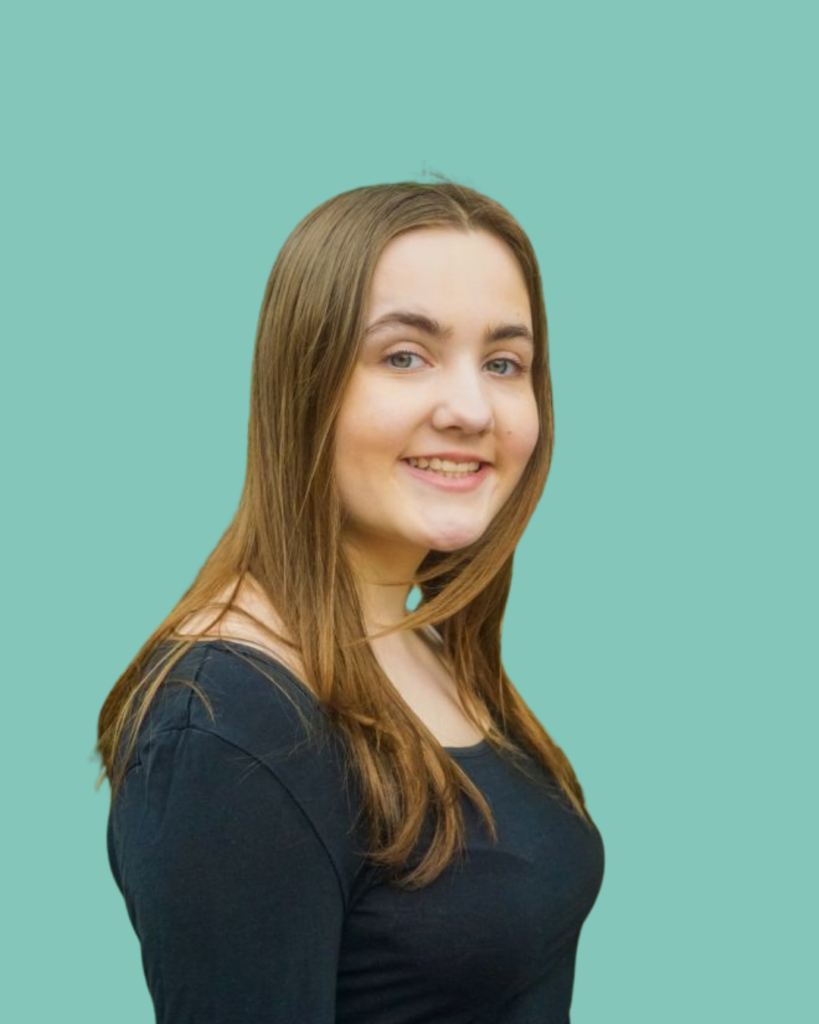
Jackie Knowlton is currently a student at the University of North Carolina at Asheville,
where she studies creative writing and French. She has previously served as a poetry
editor and design editor for the 2025 issue of Headwaters, UNC Asheville’s literary
magazine. She was a runner-up for the Top-Grillot poetry scholarship and works as a
French tutor for her school. She was recently published in Four Tulips Literary Magazine
and the Great Smokies Review. Originally from Apex, North Carolina, she enjoys
spending time in the great outdoors, exploring art museums, and she loves animals. Find her on Instagram.
- How did you become interested in poetry, and when did you begin writing poetry?
I first became interested in poetry when I was eleven years old, after being introduced to the poem “The Road Not Taken” by Robert Frost. I did not understand it at first, and this frustrated me, but my mom encouraged me to look up words I didn’t know and analyze the poem until I could understand it. This was very rewarding to me, and I became very interested in reading poetry because I like having to really analyze and think about things that are not immediately clear.
I became serious about writing poetry when I was sixteen years old, and it became a therapeutic outlet in which I was able to describe various experiences, ideas, and emotions. I have always found being creative and feeling the freedom to experiment with my writing to be very therapeutic for me.
- One of your poems is called “The Stranger in my Doorway” and has been published in Four Tulips. What was your writing process for this poem?
I have a few tarot card decks that I use to draw inspiration from when I’m writing. I used a deck called “Archetypes” for this poem. The card I drew referenced the song “Standing in the Doorway” by Bob Dylan. I listened to this song and really tried to imagine its meaning. Once I got into this mindset, I tried to write from the perspective I found in the song.
- How would you say your writing process differs from poem to poem?
My writing process varies greatly from poem to poem. Sometimes, I will have a line come to me when I am not actively writing, and I will write it down to return to later and go from there. Other times, I will sit down to write and have absolutely no idea what I will write about. I try to just sit quietly with my thoughts and discover what scenes or ideas my mind keeps returning to. I am a huge fan of art and music appreciation and sometimes I will look at different paintings or photographs or listen to different music to draw inspiration from. I like to try to write from perspectives that are not my own. For example, if there is a character from a story I find very intriguing, I will ask myself what their motivations are and try to imagine what their experiences are in order to put myself in their shoes. I have also become really interested in eco-poetry recently, which is poetry that centers around the natural world. I like to spend time outside observing different animals, and I like to center their experiences in a lot of my writing.
- How has your mentor Lee Stockdale influenced your work?
Lee has been incredibly helpful and encouraging of my work. I really liked getting his perspective on my poems because he helped me to make them better in various ways. For example, there were moments when the context of what I was writing about wasn’t as clear as I thought, and having someone else read my work allowed me to see that. He also helped me consider different ways to enjamb my poems and utilize the space on a page. He also helped me to see things from an editor’s perspective by telling me things that editors often look for when cultivating a book or magazine issue.
- You have been studying French at UNC Asheville. How has studying a language impacted your poetry?
I have tried to write poetry in French, but it is a lot harder for me to know how it is coming across because French is not my first language. I would love to read more and learn more about French poetry because I have definitely been inspired by French existentialism, including Albert Camus’ writing. I am not completely sure how learning a second language has influenced my poetry, but maybe it influences me in ways I don’t even realize.
- Where do you draw inspiration from in the world?
I get inspiration from so many different places, including movies and tv shows, photographs, strolling through my local art museum, observing animals in the wild, and my own life experiences.
- Which poets/writers influence your work or are you interested in?
I am very fascinated by Charles Bukowski’s poetry, as well as by learning about who he was as a person and how he shaped the public’s ability to interact with poetry. I am also endlessly blown away by Emily Dickinson’s poetry, and reading it feels like a spiritual experience for me. I am also very interested in Sylvia Plath’s writing, especially with her ability to describe emotional experiences.
- You have upcoming readings at Studio 116 and WCU in April. What do you look forward to when you perform at venues?
I really look forward to being surrounded by people who share an appreciation for poetry. I love getting to talk to people and to hear about their experiences and how they have become interested in poetry. It is a great way to feel connected to the poetry and writing community!
- Through your mentorship from Lee Stockdale, what is a new goal that you are trying to achieve and what is something you’ve learned that you will carry with you?
My main goal is to just write as much as possible. Lee talked about the importance of writing every day, as well as the importance of new experiences and how that can influence my writing. I definitely want to continue to enjoy writing and carry it with me towards various new adventures.
- What is a piece of advice you would give to future mentees in the Gilbert Chapell Distinguished Poet Program?
Don’t be afraid to share your work! It is really helpful to get a new perspective on your writing. My mentor was able to see things in my poetry that I hadn’t yet considered, and it was invaluable for me. I would recommend really considering all of their suggestions to form new drafts of your poetry, even if you don’t end up utilizing every suggestion that was made. Also, ask as many questions as you want! You can ask questions about things including what opportunities may be available for you, what different paths may look like in a writing career, building a strong writing practice, and anything else that comes up!
- Lastly, what are your future plans with poetry? Are there any upcoming events or publications that you will be a part of?
I have poems coming out in Headwaters, UNCA’s literary journal, as well in the Great Smokies Review, where I am working as an intern. I hope to attend graduate school for poetry, as well as publish my own poetry collections one day.