by Liz Maceda
Mary Beth shared her thoughts on working with mentor Lee Stockdale in the Gilbert-Chappell Distinguished Poet Mentorship Program. She read her work at WCU on Monday April 6th at 12 PM and will read at Studio 116 in East Flat Rock on Wednesday April 8th at 7 PM. We thank Mary Beth for her time sharing her insight and words with us. Best wishes for your readings this week and happy National Poetry Month!
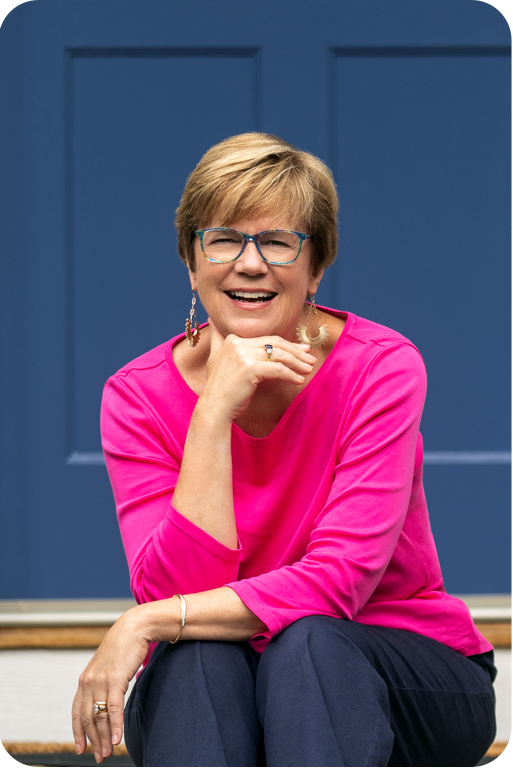
Mary Beth Stevens has spent a good portion of her life searching for just the right words. An author of four children’s books featuring her dog Tippy, Mary Beth is new to poetry and finds her inspiration in memory and the magic of everyday moments and things. A native of Iowa, Mary Beth spent many years living in the Boston area before relocating to the beautiful Blue Ridge Mountains where she lives with her sculptor husband, three dogs and one long-suffering cat. Read more about her and her books on her website and Instagram.
What inspired you to become a writer, and when did you realize you wanted to write books professionally?
I’ve always been a huge reader and a lover of words, but didn’t really think about writing a book until I was in my mid-30s. I tossed around a few ideas, but I’d been told that you needed to “write about what you know.” I didn’t think I knew enough about anything at that time to write a book, so the impulse was ignored. Years later my experiences with my dog, Tippy, provided the impetus to write the series of Tippy books as I realized that this was a subject I knew a lot about!
How has your experience working with Lee Stockdale influenced your writing in “Pearls and Possibilities”?
Working with Lee has been amazing. In “Pearls and Possibilities”, and in fact in all of the poems we worked on together, Lee’s guidance to trust the reader and not always feel as if I had to explain things in too much detail was the key that unlocked a new and exciting door for me.
The poems you share showcase emotions of both loss and joy in life. How do you balance those emotions when writing poetry?
Hmmm…good question. I find that I am writing about what I know, and the last few years have provided ample experiences of both great loss and great joy, so there is a lot to explore. Many years ago I worked with an opera coach who encouraged us singers to “be exciting, not excited.” I try to keep that in mind when I’m writing – I want to give the reader a window into the emotions I’m expressing without burying them in more than they might like to handle.
How was your transition from writing children’s books to writing poetry and what is your target audience for your poetry?
There is a lot of carry-over between writing children’s books and writing poetry! Who knew? In writing children’s books, the author learns early on that while the words are important, the illustrations are at least as key in terms of telling the story, and you have to learn to use fewer words and trust the reader to dig in and discover all that is there. Just like we poets and writers learn to trust that our readers bring their own gifts of discernment to our work – we don’t have to spoon-feed everything!
What challenges have you faced in your writing career, and how did you overcome them?
I think the greatest challenge for any writer is figuring out exactly what you want to say and then being ruthless in your re-reading to determine if you have communicated exactly what you wanted to communicate. Early in my career I had the good fortune to work with amazing writers who just wouldn’t accept work from me that didn’t do the job it had set out to do. Frustrating, but incredibly valuable!
Are there writers or books that have inspired your writing style?
If you know me, you know I love the work of John Irving – I adore quirky fiction with quirky characters! I’ve no idea how his work has influenced me, but I would love to learn more about how to incorporate a sense of play and absurdity in my work.
Since you live in North Carolina, are there any local bookstores, literacy magazines, or writing communities you recommend?
I wish we had a few more indie bookstores in Western North Carolina, but of course, Malaprop’s comes to mind. I also love to visit M. Judson in Greenville, SC. I’m just now digging into literary magazines and learning, learning, learning by reading, reading, reading! The North Carolina Poetry Society and the NC Writers’ Network are terrific organizations!
What message or feelings do you hope readers take away after reading your work?
I hope that readers of my work get a sense of honesty and vulnerability – that I’m writing about real stuff, and that real stuff is universal. The thing about poetry that I love the most is the possibility that a reader can read a poem and say, “That’s EXACTLY how I feel! I’m not alone!” In that way, poetry serves as a uniting energy in our world.
What important life experiences have had the biggest impact on your writing career?
Well, there have been some biggies…the loss of both my parents and one of my brothers. Taking a look at the dynamics of my family of origin and working to understand how those dynamics have influenced my life and choices. Serving as a caregiver and going through the end of life with my late husband, and then experiencing the unexpected joy of meeting my current husband and love, David.