
by Jackie Knowlton
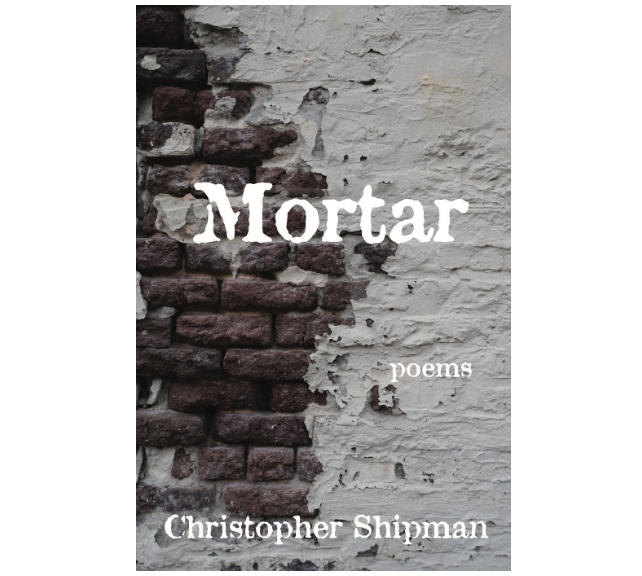
Shipman describes the nature of his family dynamic, in which a brick used by his uncle as the weapon in his grandmother’s death forever stains the way that the speaker sees his family and his relationships to them. He writes “a brick/will become/something bigger/than itself:/wall/road/murder weapon/well/doorstop/fire pit/window prop/hell” in “brick.” Shipman’s poems are set in various homes of his, including Arkansas, Greensboro, North Carolina, and Asheville, North Carolina, showing the ways in which memory follows him no matter how his physical home and situation change. Christopher Shipman’s Mortar explores how the generational trauma in his family’s history impacts the everyday challenges of his own fatherhood. He accomplishes this through sprawling imagery presented in a stream of consciousness writing style.
The word “brick” is repeated throughout the collection, both as the single-word title of several poems and as a repeating force found in prose poems. The word “brick” gives the feeling of fragmented memories, contaminated by the constant reminder of the tragedy that its image symbolizes. In some instances, it is as though the word is serving as punctuation. This is shown in his poem, “Missing Headline” with “I’ll pull this car over brick I have a voice like elvis brick don’t you think brick when I sing brick I’m moving out for a bit brick not long brick a month or two brick maybe brick.”
The brick becomes a barrier that separates the speaker from his father. It is as if his father cannot see his family without seeing the tragedy that defined his family’s past. Similarly, the speaker will always see the tragic incident of the past when he looks at his father. He has never known his father without knowing of the tragedy. He says in “Prologue,” “When I miss a call from my father, /I imagine him standing/in the palm of a river. An arcane sadness/sandbagged behind the years/that followed him there.”
Within each of the poems titled “brick,” there is a clear emphasis on the economy of lines. The poems under this title are often broken up into what appears to be blocks or bricks. The sections are entirely separated, often with the first stanza assuming the top left part of the page, while the second part of the poem makes up the bottom right space. This provides contrast to the other poems throughout the work, showing how the symbol of a brick brings up a theme and feeling of isolation, portrayed through the structure. The placement of these poems between others that have longer lines reflects the inner conflict existing in the family’s spirit, that there is connection between them as well as conflicted feelings that lead to isolation.
Despite the word “brick” appearing 150 times in the collection, the title presents the overarching focus. For Shipman, family remains connected for better or worse. He seems to summarize the nuance that is balancing brick and mortar, or family and memory, when he says, “clay or shale unlike metal/melts gradually/softens slowly.” .He presents an image in which something once hardened, “clay or shale”, has the ability to melt and take on new forms over time. The melting, for example, symbolizes Shipman’s own transition into fatherhood. In doing this, he presents the idea that there continues to be family growth amidst the fixed nature of past tragedy.
The poems found between the ones titled “brick” contain a fluidity that may be interpreted as the mortar that connects memories, as they do not contain the same visible rigidity. In “Missing Headline,” for instance, there are no space breaks and the words flow unyieldingly, as if melting, connecting and linking family members to the same tragedy; the tragedy becomes a part of the family that will be passed down, even when there continues to be familial growth.
The collection is aptly named, as I find myself gaining an appreciation for the mortar while reading this collection. The family’s ability to grow despite the tragedy that does not go away is bittersweet. The reader remains constantly aware of the presence of bricks, as Shipman cleverly intersperses the poems of this title. He does so in a way that mimics the nature of a house, brick and mortar exist side by side. Similar to Shipman’s feelings, the reader becomes dedicated to learning of his current journey with fatherhood, while being constantly reminded of the past tragedy with Shipman’s use of repetition, both with poem titles and contained in the lines within poems. He achieves a stark image of the nature of generational trauma, in its tendency to resurface and linger years later.
Christopher Shipman lives in Greensboro, NC, where he teaches literature and creative writing at New Garden Friends School. His work appears in journals such as Fence, Poetry, Sixth Finch, & The Southern Review, among many others. His poem “The Three-Year Crossing” was a winner of the 2015 Big Bridges Prize, he has twice won the Editor’s Choice for Rattle’s ekphrastic challenge, & his work has been supported by the North Carolina Arts Council. His play Metaphysique D’ Ephemera has been staged at four universities. Mortar, his most recent poetry collection, won the Brick Road Poetry Prize. More at www.cshipmanwriting.com, Instagram: @ship_on_the_line, Facebook: @christopher.shipman.9