
by Rishi Janakiraman
Sneha Pannala shares how the Gilbert-Chappell Distinguished Poet mentorship allowed her to deeply consider language, interpretation, and revision with respect to her own work. She discusses the inspiration behind “The Spirit of the Wolves,” her affinity for ambiguity and memory, and the ways Gideon Young both strengthened her work and preserved her voice. Thank you for providing so many insights in this conversation, Sneha!
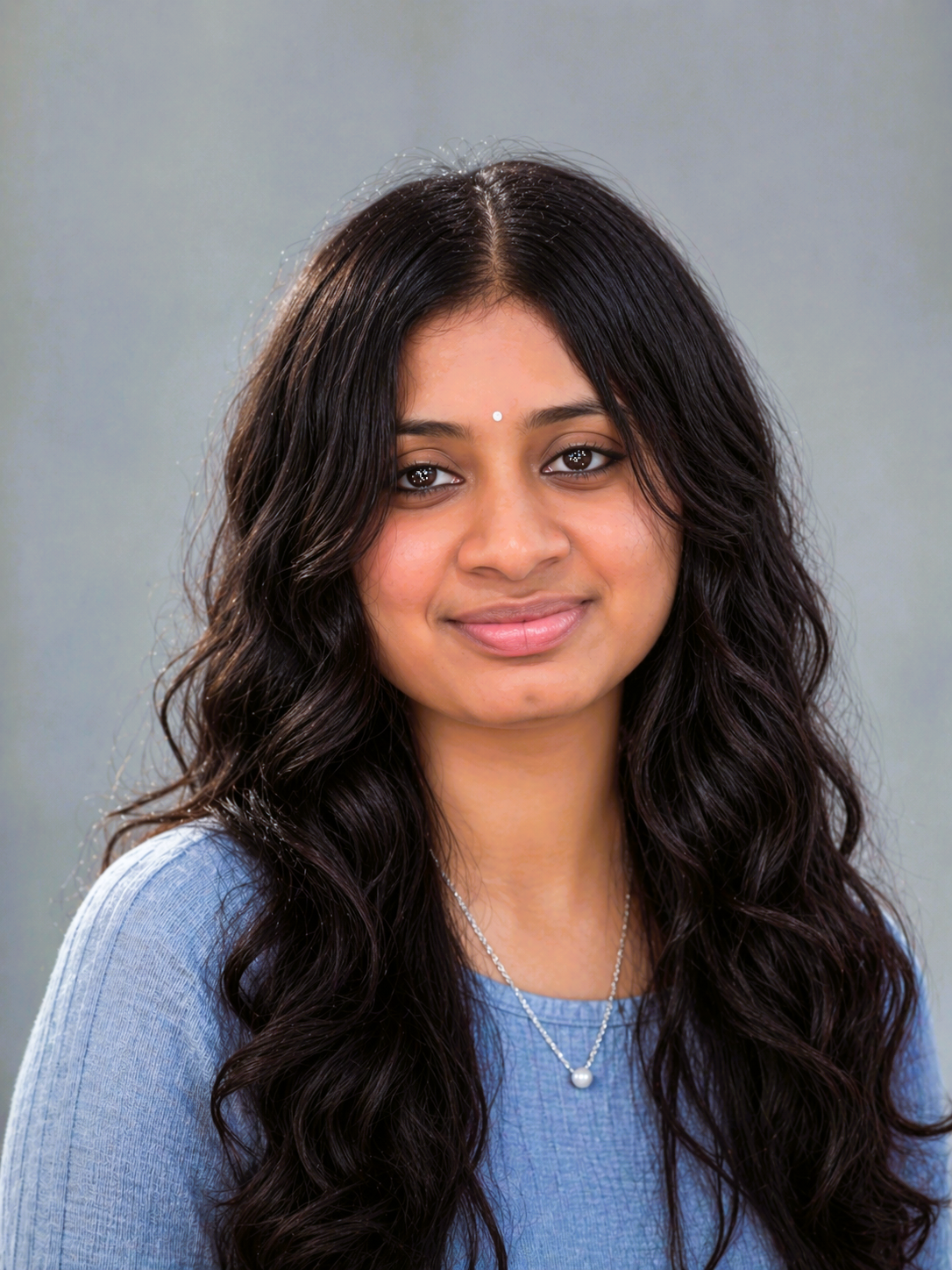
Sneha Pannala is a student at Northern Guilford High School who writes poetry as a way of exploring the spaces between thought and language. Her work reflects an interest in how meaning can shift through word choice, sound, and structure, often leaning toward ambiguity and reflection rather than fixed interpretation. As a 2026 mentee in the Gilbert-Chappell Distinguished Poet Series, she has been grateful for the opportunity to learn from and engage with new approaches to voice and form. Outside of writing, she enjoys reading mystery novels and spending time with her pet cockapoo. Her work continues to be shaped by an ongoing curiosity about how language can both reveal and limit what is understood.
How was the Gilbert-Chappell Distinguished Poet mentorship for you? How did working with Gideon Young give you a space to think differently about your own craft?
The Gilbert-Chappell Distinguished Poet mentorship was one of the most rewarding writing experiences I’ve had. Writing can oftentimes feel solitary, so having the opportunity to discuss poems with an accomplished poet and receive thoughtful feedback was really valuable. And Gideon Young created an amazing space where I felt comfortable experimenting, asking questions, and thinking more deeply about the choices I was making on the page.
One of the most impactful aspects of the mentorship was seeing how another reader engaged with my work. Several times, Gideon pointed out possibilities and interpretations that I hadn’t consciously considered while writing. That experience encouraged me to view poetry as more of a conversation between writer and reader. It made me more aware of the layers of meaning that can come from a poem and to the process of improving those images by incorporating specific and surprising details.
You’ve mentioned that you’re interested in the relationship between thought and language. I’m wondering, then, how do thought and language intertwine in the writing process for you, i.e., how does your language constrain your intended meaning, and how does your intended meaning constrain your language?
I believe thought and language are constantly shaping one another. Whenever I start writing, I usually start with a feeling, question, or image that exists in a form much less precise than words. The challenge is that language can never perfectly capture an internal experience. Every word carries its own associations, connotations, and limitations, so the moment I choose a word, I’m also narrowing the range of possible meanings.
At the same time, my intended meaning influences which words I allow into the poem. If I’m trying to keep a sense of uncertainty or complexity, I might choose language that leaves room for multiple interpretations rather than language that explains itself. In that sense, the writing process becomes a funny kind of negotiation: thought tries to press against the boundaries of language, while language gives it a shape that readers can encounter.
Your interest in ambiguity is also deeply compelling to me. When were you first exposed to this idea of ambiguous interpretation, and what was that experience like? On that note, what’s the process of reading poetry like for you?
Long before I encountered ambiguity in literature, I think I was drawn to it without realizing it. When I was younger, I loved “reading” picture books by inventing stories from the illustrations, and my sister and I would spend far too long debating optical illusions like the duck-rabbit image, each convinced our interpretation was right. Looking back, I think what fascinated me wasn’t arriving at the correct answer, but realizing that the same image could honestly be seen in different ways.
I felt that same feeling years later when I began reading and annotating poetry and literature in school. I loved (and still love) finding double meanings because I could slowly add my own interpretations, making part of the poem feel more personal to me.
As I continued writing, I found myself wanting to read more poems that could be read in a different light. They just felt more reflective of real experiences, which are also usually uncertain, contradictory, and difficult to articulate. One idea that I love exploring in my own writing is memory—how memories change over time, how different people remember the same event differently, and how those differences shape our understanding of reality. Exploring memory naturally led me towards ambiguity because memories themselves are almost always incomplete and open to interpretation.
Ambiguity in this way feels as though it allows readers to participate in creating meaning, and I think that collaborative aspect of interpretation is one of the reasons poetry is so engaging.
When it comes to reading poetry, I don’t always understand the poems I read—or even the ones I write, for that matter. Yet when I allow the emotions carved into the page to wash over me, the words, in their entirety, don’t need to be completely understood. That realization has only made me appreciate poetry even more. Then, after sitting with those emotions, I love returning to the poem to annotate its word choice, structure, imagery, and rhythm, discovering how those elements shape the feelings I experienced and, in turn, improving my own writing.
In your own work, what are some of your favorite literary devices and techniques to use, and how do you use these to your advantage?
Some of my favorite techniques are symbolism, extended metaphor, imagery, rhetorical questions, and sound devices such as consonance and repetition. I love using symbols because they can communicate ideas indirectly, allowing readers to discover meaning rather than simply being told what to think. Even when you step away from poetry, you find that symbols can shape other art forms. For example, Salvador Dali’s paintings of melting clocks and breaking eggs present many interpretations for the viewer; however, for the painter (or the poet), the meaning can be quite simple.
I am also particularly interested in imagery that suggests emotional states through physical details. Rather than describing an emotion directly, I often try to build an atmosphere or setting that allows the emotion to emerge naturally. Sound devices are important to me as well because poetry exists not only through meaning but also through rhythm and sound. Even subtle patterns can influence how a reader experiences a line.
Your poem, “The Spirit of Wolves,” constructs such a rich setting, one that allows the reader to imagine the wolves, all while there is no mention of a wolf in the poem’s body. What was the intention behind this choice? In what ways does your poetry imagine subjects through their surroundings (“wounded prey,” “mournful call,” “wild release”) rather than through the subjects in themselves?
I feel that I really wanted to allow the wolves to exist as a presence rather than simply as characters. I was interested in the traces they leave behind—more specifically the effects they have on the landscape, other animals, and the atmosphere of the poem. By focusing on those surrounding details, I hoped readers would gradually construct the wolves in their own imagination.
To that end, it seems that sometimes a surrounding image can reveal more than a direct description because it invites readers to participate in making connections. In “The Spirit of Wolves,” the prey, sounds, and landscape become evidence of something larger that remains partially unseen. And, as mentioned earlier, that tension between presence and absence is something I frequently explore and enjoy playing with in my writing.
There is also a crafty use of sound in a particular line: “this time with the patter / of several smaller feet.” What do you see is the significance of the consonance here? How does the sound of the line complement the line’s imagery?
The repeated soft consonant sounds help create a quieter and more delicate rhythm than many of the surrounding lines. I wanted the sound of the language to echo the image itself. The repeated sounds mimic the light footsteps being described, creating a sense of movement that feels gentle and almost audible.
Because the poem contains both wildness and tenderness, that line, I feel, is the moment where the reader can feel a softer side of the landscape. The sound contributes to that effect by slowing the pace and drawing attention to the image’s subtlety.
Do you think that, in the development of this poem, Gideon Young gave you a different perspective on it? How did hearing another person’s interpretation change the way you went about writing it?
Gideon Young really helped me develop this poem into what it is now, mostly through word choice changes and direction. For example, previously, I leaned into the words of the story; however, Gideon helped me realize that developing the imagery would really strengthen the beginning. Beyond this, he also helped me add specific details and develop a storyline that would feel chronologically sensible while bringing even more of the natural world to life.
By hearing Gideon’s own interpretation of my initial storyline, I was able to understand which areas might need more working for clarity. A poem about nature and the bonds between wolves is a work that requires crispness, detail, and musicality—a way to create the feeling of one paw guided by many.
One aspect I really enjoyed during the Gilbert Chappell Distinguished Poetry Society mentorship, and with Gideon Young’s mentorship, was that the voice of my poetry was preserved. Gideon never tried to change the entire poem; he instead left meaningful comments that really opened up my poetry and created stronger images within it. Before, I hadn’t realized how much effort was needed to create a finished piece, but after this mentorship, I found that the revision process is nearly never-ending. A poem is never completely finished; however, it can be brought to a state of near completion—something that captures your heart in the fullest way possible.
-Sneha Pannala
What are your plans for writing poetry in the future? And how has the GCDPS mentorship helped you on your way to achieving them?
I’m going to continue developing my craft of writing poetry throughout high school, college, and beyond. Poetry has slowly become one of my favorite ways to explore ideas, questions, and experiences that are difficult to express in other forms. For anyone interested in MBTI personality types, I found that I’m an INFJ, and when a day is particularly stressful, I don’t want to wash over those difficult events again and again. So, interestingly enough, I find that poetry gives me a place to spill those feelings onto the page while also bringing a sense of closure. However, rather than writing a chronological narrative of the day’s events, I can use poetry to journal my ideas, thoughts, and feelings of that day, carving instead an emotional arc that I can tuck away.
Moving forward, after focusing on revising a few more pieces of my poetry, I plan on moving into publishing my work in a collection of my own pieces. But, as of right now, I’m very proud and excited that this year’s mentees and Distinguished Poets have the opportunity to display a little of their work in Witness: Appalachia to Hatteras, which will be released in August! They all have extraordinary talent in the creativity of their expression, and I feel honored to have my work shown alongside theirs.
The GCDPS mentorship has, altogether, given me greater confidence in my writing and a deeper understanding of revision. More importantly, it showed me the value of the literary community. Writing can feel like an individual pursuit, but this experience reminded me how much growth can come from thoughtful conversations with mentors and fellow writers. I know that the lessons I learned through the program will continue to shape my work for years to come. Deep gratitude to all those involved in the creation and maintenance of the Gilbert-Chappell Distinguished Poet Mentor Series, including Kelly Jones, our coordinator; Gideon Young for his tireless pursuit of bringing the best out of this year’s mentees; my Creative Writing teacher for her unwavering support in creating a space to write inside a chaotic school; my family, peers, and pet cockapoo who are also poetry enthusiasts (woof!); and the late Fred Chappell, who founded this program and shaped many writers today. To those who took the time to read the words I wrote, I wish you all the best on your writing journey! The world is endlessly beautiful, and no two people will ever see it in quite the same way. Write what only you can.