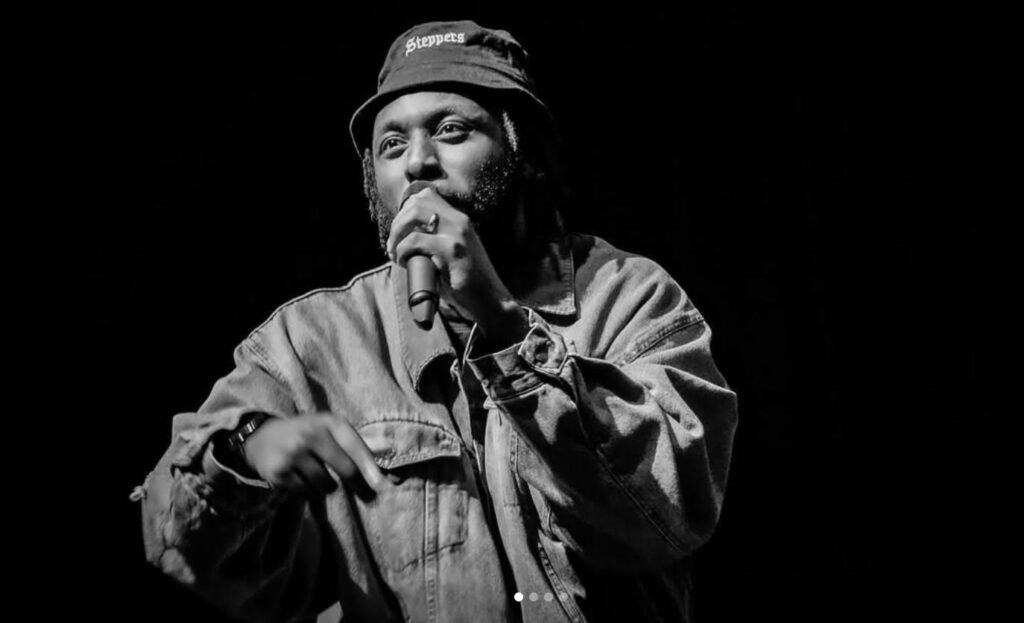
A heartfelt conversation with spoken-word artist and poet laureate of Greensboro, James Daniels on his own journey within the poetry space and his encouragement for aspiring poets
By Jackie Knowlton
James Daniels // james solomon is a Black Southern creative, educator, and community peacebuilder with poetry publications under Southern Cultures, Greensboro Review, SoftSavagePress, Stonecoast Review, Cherry Tree Literary, EcoTheo Review, SuperEmpty Magazine, Windhover Magazine, and others, as well as Bull City Press who published his first chapbook God-Damned Eden. He’s been teaching writing and hip-hop for 15 years, and he is currently the professor and coordinator of Creative Writing at North Carolina Agricultural and Technical State University. He has also been engaged in artist organizing and community work for 10 years, including his current work as the CEO of Sol Lxve Creative Studios, LLC, an indie creative studio dedicated to providing media, organizational, and craft services for writers and musicians to produce meaningful projects; as an organizing member of an arts collective dedicated to aiding folks in becoming full time artists—Fire and Light Collective; and as Greensboro, North Carolina’s second Poet Laureate. When he is not working, he can be found freelance piano-ing, video gaming, reading, spending time with friends and family, and scouring the world for the best pizza.
To keep up with his events and releases, follow him on Instagram @jamessolomon___ or visit sollxve.com.
In this interview, James Daniels gives insight on a variety of topics, including strategies for active reading, advice for those who are new to the poetry scene, and the impact that teaching poetry has for young people. He also discusses how his personal experiences, such as his experiences with music and family, have shaped his poetry. He shares craft insights, including the importance of musicality and rhythm in poetry and how they shape the overall structure and presentation of his work.
Thank you, James, for this inspiring conversation!
I read that you have not always been an avid reader, but became interested in reading when it came to poetry. What was it about poetry that allowed you to feel motivated to keep reading?
Haha, this is a great question! To be honest, I used to hate poetry, too, but I was really into hip-hop growing up. I listened to Lil Wayne, Kendrick Lamar, Kanye West (before the crashouts), and other classics. Two of my high school English teachers were the ones to encourage me to join the Poetry Out Loud competitions after reading maybe the seventh or eighth assignment I wrote a rap for. The rest was sort of a “Dead Poets Society.” What made it different for me, though, is that I didn’t just grow a love for poetry that erased my love for hip-hop and music in general—I built a love for language that made me hungry for books, movies, music, marketing, and so many other avenues that use language creatively to communicate and comprehend ideas.
Poetry itself is a cool vehicle that I’m still learning to drive, but the cargo—or rather the motivation—is continuously figuring out how to understand and respond to the world effectively and creatively; so, in a sense, I had to push myself to read to understand that craft.
James Daniels
What advice would you have for someone who struggles to see themselves as a “true reader” because they struggle with reading slowly, finding the right genre, etc.?
This is something that I deal with daily, so the answer’s pretty fresh for me. I’ve found in my experience as an educator that there are two sides to this—the identity side of being a “true reader” and the practical side of what to do about it. On the identity side, I struggle with the title of “reader.” I get that being considered a “[true] reader” signifies that a person reads more than the average person might. However, we all do the work of comprehending language, thinking about it, and responding based on what we understand, and if that’s not a “true reader,” I’m not sure what is. So I’d say that, if you’re engaging with text in any meaningful way, then you’re a “ reader” in the philosophical sense. Practically speaking, though, I’m not naive here, so I understand that the issue stems from what “true readers” are actually thinking: that “true readers” are better than who they’d consider “non-readers” because they are “more informed,” and being a reader means, as you said, reading a lot of text and either enjoying or being able to critically engage with everything that you read regardless of whether or not it’s interesting or comprehensible. If that’s the definition of a true reader, then I, a published writer and author, an Assistant Professor and Director of Creative Writing, and a language teacher of 10+ years, am not a true reader, and it’s largely why I still don’t consider myself one. It’s too much pressure! So, the “advice” I’d give is to first shoot me an email and let’s get a good book list for you—it’s my personal love language and a solid 50% of what I did for my degree in Education—and secondly, I’d say to, instead of worrying about this mythical moniker of being a “reader” that only fanatics or people who do this for their job are able to achieve, focus on finding bite-sized chunks of things you enjoy reading and keep reading those things. The fanatics will be okay.
In addition to being a poet, you are also a musician and pianist. How does music influence the way you develop your poetry? How important is musicality in poetry for you?
Oh my gosh, it’s everything. Music is my first love! It was the first language I truly learned how to speak well. When I was young, I sang in the children’s choir, which is an embarrassing piece of lore that you’ll be the first to break to the world, so congratulations. After that, though, I eventually played piano in church for about eight years. I still play piano for my friend Kay Marion’s band, and I believe all of these experiences alongside my extensive music listening informs almost everything that is good about my poetry. That’s why, to this day, when I write a poem, I aim to first speak the language of music before ever putting a word on the page.
Whether I’m creating original instrumental or rap music or penning a poem, I always find the syllable count or hum the rhythm of lines before the words. This, in part, comes from being introduced to the poetry I originally liked in the form of spoken word with folks like Danez Smith, Elizabeth Acevedo, Matthew Cuban, Aleysha Wise, G Yamazawa. In general, though, I knew that poetry takes time for folks to digest, so I wanted to find something that readers could hold onto while they rode through my poem. For many people, they give images for readers to rock with, and I love and try to prioritize rich images in my work, but I want my poems to sound good. This has been solidified in recent years as I’ve attended poetry readings where, when listening to people read their poems, I notice that not only is there little to no music in their voice and reading of their otherwise amazing poems, but also, almost as a result, there’s little to no excitement about or pride in their poems. I don’t want that to be the case for my poetry.
Before polishing, before image, before craft, even, rhythm is always first for me because the clackity drumming of pencils on desks and the well-timed shouts of spirit-filled aunts and uncles and the uniquely rhythmic stomp of praise dancers and the bumping bass of songs we weren’t allowed to listen to as kids beating the clouds different colors at family reunions and the songs both of my grandmothers would hum and so on and so on and so on were all my origin, so to forsake that in my language would be to forsake myself, and that, to me, is the antithesis of the freeing art form of poetry.
James Daniels
You provide spoken word workshops for people, where you focus largely on providing services for young people. Can you talk about the importance of promoting poetry to young people? What is the most common piece of advice you find yourself giving your students?
To answer your first question, giving young folks language is one of the most powerful, yet one of the most dangerous things that we can do, and I think that danger is something I’m interested in letting young folks run with.
There’s an essay by Jack Collom and Sheryl Noethe titled “On Sound In Rhythm: A way to start teaching poetry to children and young adults,” in which they argue that we should teach children rhythm because the best rhythm we’ll ever see in the world is from children because they are so open to exploring it, and this trait in young people stretches beyond rhythm and into all that they do—it makes them better, more efficient people, too.
At some point, we are indoctrinated into misery as we are told to grow up, take responsibility, create less, and care more about outside opinions and careers than cultivating internal joy and lasting peace, so I believe it is important to promote poetry to young people for the same reason that I believe it is important to promote it to adults, to folks whose identities are constantly attacked by government, and so many others: we must maintain our childlike creativity to thrive in a world that is hellbent in snatching it away. Think of the problems that we could solve if we had folks who could be more open to differing perspectives and love on those folks who have them while still critically responding to them, who could play creatively with ideas and through that play morph them into solutions to our world’s issues, who could be in tune enough with themselves to know when they need to go away or play with something else before coming back to an issue to be more effective, and who was generally a better person to their neighbors, coworkers, community members, and everyone around them because of how fulfilled they were after building in the opportunity to be creative. I think we’d have a better world as a result.
I am sensitive to the fact that we genuinely do have to pay bills, work for a living, and take care of the people around us, and there’s a beauty in being given this responsibility to steward. I am also sensitive to the fact that not everyone has the luxury of “playing” enough to be fulfilled, as they may have external circumstances like homelessness or poverty, as well as internal circumstances like addiction or mental health disorders that prevent them from accessing play and creativity, since their ultimate goal is daily survival. I argue that creativity and play are often the solution for a lot of these issues, though, in that they truly do fulfill us and, when applied to solving the issues mentioned above, get us to a better place. To that end, the most common advice that I give my students is that 1. “Poetry is honesty,” a quote I stole from Matthew Cuban, 2. Poetry is play, so play, play, and play some more, and 3. Poetry is love, so find something/someone that you love and give it your full attention in a poem or series of poems. That’s all I’ve got!
You have expressed wanting to “build bridges” in the creative community over the course of your laureateship. What does building bridges look like for you, and in what ways do you hope to increase inclusivity?
Building bridges looks like peacebuilding, a term that comes from my personal faith. This concept, as I understand it, means stepping into realms of conflict or problems that need to be solved and engaging with them in love for people, community, and place in order to maintain and create the beauty that lives in those spaces while preventing or repairing the harm done to that beauty. The harm I see done to the beauty of poetry is the separation between poetic communities, usually because of elitism, craft differences, and just the cliquey nature of creatives.
I aim to “heal” this harm by bridging the gap in several ways, the first being bridging the gap between community and institutional academia. There are obviously some differences that we have to address, but I think we often forget that the students, educators, and administrators who make up the university and academic institutions are also a part of the very community that they sometimes distance themselves from. We honor the hard work that it took to get published, or become a professor, or to be a student studying the craft of writing, but we also honor the communities that made it possible for something like that to even exist in higher education alongside their expertises, and we privilege neither. I aim to do this by ensuring that the students I can come into contact with are pushed to engage in the literary spaces of my community, like the traveling Poetry Cafe, Demhaj Poetry Lounge in High Point, North Carolina, the Village City Slam, and so many other spaces. I also aim to bridge this gap by asking community members to not only invite folks in academia but also to engage in some of their activities and readings, as well.
There’s also a divide that often happens between “the page and the stage,” as many spoken word poets might call it, that genuinely shouldn’t be there. Both make way for the other, but there is somewhat of an elitist view from poets who are traditionally published that leaks out in their poor reading of and lack of connection to their work, while there is a fair but misplaced disdain from spoken word poets towards traditionally published poets that has them believe that, since published poets sometimes can’t do what they do on the stage, there must be no merit in publishing on the page at all. Greensboro seems to deal with this less, so I’m not actually going to have to do too much work to build this bridge, but I see there being more workshops like the ones I run with Josephus, our previous poet laureate, where folks are learning to critically engage with their work in such a way that they can read it on the stage with the same conviction that they wrote it with. Likewise, I want to support spoken word artists in pushing their craft in a way that helps them write on the page what they’ve said aloud with the same conviction and craft, often making their spoken work better as a result. Lastly, I recently launched a Southern creative studio dedicated to supporting artists in creating and publishing work that inspires people to heal, create, and live more fully, a venture I’d use as Poet Laureate to continue pushing restoration and providing opportunities for poets to flourish.
How has the work of other artists influenced your own work?
I am encouraged and influenced by Tyree Daye, who takes his small town of Youngsville and truly makes it a “[town] set on a hill,” using dialect, family stories, collage, and other creative (and deeply Southern) manners of craft to communicate the message of the places and people that have shaped him. I am also inspired by Elizabeth Acevedo, who explores her home of New York as well as her generational and family home of the Dominican Republic in ways that I also want to. Other artists are those right around the corner for me! I think of BlackSpace in Durham, NC, specifically the poet, cultural commentator, and arts organizer (A)Lani Rouse, and the hip-hop connoisseurs .zone, JAMMTheNubian, math.i.as, Khalil Nasim, and J Rowdy (Rest In Peace). There are other artists not a part of BlackSpace—like Watty the Shepherd, Henry Cole, Dreco, LestheGenius, Eugenius, Katie Blvd, Kay Marion, e.s. Hampton, J.Da Storm, Nubian Collective, and so many others—but what these artists empower and elevate is a Neo-Southern sound that I find myself emulating in much of my music, of course, but also in my poetry as I consider rhythm, diction, and authenticity. Cole Arthur Riley’s work, her enlightening perspective on spirituality, and a liberation based on the stories we carry in ourselves also guide the way I teach, create, and love those close to me. I am lastly encouraged and influenced by J. Cole for the dedication to the craft and authenticity that I attempt to mimic in my writing and life. Lastly, I have to mention two artists that kind of go hand-in-hand even though they’re from different generations—aja monet, a self-described “surrealist blues poet” who brings together jazz, soul, and poetry so beautifully, and Langston Hughes, who was a forerunner for this kind of work and continues to inspire the connection between music and poetry for me to this day.
What does being appointed as Greensboro’s inaugural Poet Laureate mean to you, and what legacy do you hope to leave this position?
It’s first of all an honor and a blessing from God, so the word that keeps coming to mind is steward, and that’s hopefully the legacy that I leave in this position—one that demonstrates that the role and power of poet laureate is not for any one individual, but rather for one individual to help care for, love on, and stimulate growth in poetry within the city. Of course, it’s about building bridges, but that is because I am a people’s poet first, and a peace poet second, and these are always informed by a spiritual love geared towards seeing the beauty in all people and providing a medium for a more restorative view of ourselves and the communities around us. For me, this is the sacrificial and daily compassion and love of Christ, but for the many other folks who connect spiritually to different faiths or varying nonreligious practices and rituals, I mean “spirit” as the web of connections between us all that create the communities we are in.
Greensboro has a spirit that I will love on and celebrate in as many ways as I can build capacity for by serving its people through poetry, continuing to strengthen and start initiatives that allow us to share our voices and stories, and aiming to stand in the center of conflict where needed to support the hurting and offer a bridge towards restoration through creativity. I do this because I live in Greensboro, which means I laugh with Greensboro, I lament with Greensboro, I stand in the center of conflicts to fight for Greensboro, and I ultimately want that spirit to flourish. I just pray with everyone’s help here and across the city that I steward this well and create a poetic community that looks like all of us.
I have noticed that many of your poems utilize open space on the page between words, lines, and stanzas. I saw this in the way that many of the lines were indented in “Last Night” and in how the stanzas were spaced in “Fieldnotes Tracing Our Backwoods: 20 Questions for Newcomers”, “Looking for a Sign”, and “Hiding”. What is your process in utilizing open space? How do you determine where a line or stanza should incorporate open space?
Great question! Thank you for reading my work so intentionally and deeply. It means the world, really. In a larger sense, it always comes back to music and rhythm for me. I think there’s an aesthetic rhythm in my work that I sometimes don’t know how to get across since I only have the words, so I try to play with open space sometimes to achieve that rhythm. It’s hard for many writers to think about because we’re rarely considering the visual pleasure or purpose of our words on the page, but I think that’s the cool thing about poets and poetry. The line breaks are just the beginning for us, and we get the opportunity to find so many different ways to say the same thing, even with the same words on the page! I have more I want to explore with that, but that’s the general impetus.
In a more acute sense, since I have a tune for music, I typically break a line where there’s a breath in how I naturally or performatively speak it aloud. I choose to break stanzas when there is a new or shifting idea that I want to get across, and I use wider space when I want my readers to take a mental breath and sit with some of the words, phrases, or ideas a little longer. It’s not quite the rocket science that I or other poetry teachers make it out to be, since it can so often be so subjective, but that’s the simple process that I tend to stick to unless I’m flying off the page towards something wilder!
The closing line in your poem, “Hiding” really struck me, when you write “I hope you know I’ll tangle myself free.” Can you talk about your process of closing the poem in this way?
Yes! This is one of my favorite lines, and it ironically didn’t come until one of the later iterations of the poem. I think that it was something along the lines of “And I hope you know that I am making myself free” in some of the first iterations. This obviously isn’t much different, but the verb “tangle” sat in my spirit for the longest because, when I think about this poem, I think the main idea was that being “free” was a messy process, and that freedom didn’t seem synonymous with openness or even a breath of fresh air. I think back to the themes of Black experience in this poem, from my experiences as an educator to my experiences at protests to my experiences with my family to my experiences with my hair. I think of the scars that I and so many other folks have on our physical and spiritual bodies as a result of what we’ve gone through, and similar to the old sentiment of learning history in order to not repeat it, I want to hold onto all that made me and bear those scars so that I never forget what made me who I am. What still makes me beautiful. It’s why, unless they start falling off of my head, I probably won’t cut my locs again. They carry so much history. It’s even why I still have my first batch of locs in a ziplock bag in my and my wife’s linen closet, and it’s even why Black folks have cut them off before when they need a spiritual release from some of the things that they’ve gone through.
For me, though, in this season of life, I won’t be defined by what I’ve been through, but I will be defined by the beautiful being that I am as a result, just like my locs. They might be tangled, but they can breathe just fine.
I notice a strong theme of family throughout your writing. You even speak directly to your grandad in the closing stanza of “Hiding.” How does family influence your storytelling? Do you often feel like you are writing directly to family members even when you are writing for many people?
It’s funny that you mention my grandad, God rest his soul. He was one of my favorite storytellers, and one of the best at that. It was truly a privilege to have someone who took such pride in telling stories so casually, yet so intentionally that it could captivate folks of all colors and walks of life, even in the early 20th-century South, which, if you know your history, is saying something. Needless to say, he shows up in a lot of my poems, though I don’t always talk to him directly. I think of my grandmother, too, who admittedly doesn’t show up in this manuscript since she and other family members of mine are in a longer manuscript about the Black South and our beauty that I am shopping out right now! She is a huge reason that I write and tell stories, too, because I always joke that she used to make me write a synopsis of what happened and what I learned after I’d get in trouble, and then grade it for grammar and structure. It’s crazy to think about, but I can’t thank them or any of my other family members enough for telling me their stories and offering their skills to tell them well.
To really answer your question, though, family is a touchy subject for me since my parents separated when I was 15, and even before then, we were never really a typical nuclear family. My mom, my dad, my brothers and sisters, my aunts, my uncles, my cousins, and of course, my grandparents I think it’s a subconscious reach towards the idea of family that I wish I’d had, especially in the South. Here, you get so many “family members” that you start to get confused about who you’re related to. Everybody is “aunt this” or “cousin this” or “like a brother,” so it wasn’t that I felt like I didn’t have family, it was just that the people I was related to didn’t seem to fit that mold, especially as I read through other Southern authors’ engagement with their families. We weren’t necessarily volatile; just distant. In that sense, I guess I am always talking to family even when I’m sharing with other folks, even the dead. I just want to make that connection in my poetry with the hope that it’ll manifest in my interactions with them in my daily life. I’m still figuring this out, to be honest, but I hope that answers your questions!
What advice do you have for people who struggle to find their place in poetry or are nervous about joining the poetry scene in fear of not understanding everything?
There are two parts, and the first piece of advice is to go there. Go to her. Poetry, that is. Go to her and go to her often! Always go to her! Folks who are nervous have often already done the work of looking up places to go or they know how to find it, but they fear rejection. And that is so fair. We all work hard on our poems and oftentimes put our entire selves into those poems, so sharing even with the most open crowd can be absolutely nerve-wracking, and that’s at the best of times. However, you have to be in the poetry spaces to eventually build in those spaces. I tell folks all the time that I didn’t start going to our local Poetry Cafe with Josephus Thompson III as a performer. I started as a busboy. I couldn’t afford the ticket price as a grad student at the time and I wasn’t sure how my poems would come across, so I reached out to Josephus and asked him if he needed any help, and it turns out that he did. I did the same with the open mics, too!
The best thing to do if you’re feeling nervous or fearful of going into poetry spaces even though you want to be in community and share your poetry, start by just being in the space as a volunteer or a spectator. Go to the open mics and events, especially the free ones, and just listen to what folks are saying. Who did you like? Who did you not like? Why? What do you think your poems have to offer? And always remember that there’s only one you, so your poems have something to offer, even if the others are better than you.
The second and final part is to not share at the open mic first. Granted, you might be bold and want to just dive into it head first. I think that’s great, and you can skip this part if that’s you! If it’s not, though, find your closest friend, an online forum like poetry.com or substack.com and share something. You might not get validation, but don’t tell anyone else and just share that thing. Let it sit out. Get used to it being out to that close person or that online forum where someone can see it and you’ll most likely open up enough to share it elsewhere.
So, in summary: go to the spaces, serve the spaces, and then share your work with a trusted person or closed online forum. I think that this is what’s always put me in the best position, and I’ve seen it do the same for many others.
What is next for you? How can we view your work?
Nothing too crazy! I’ve got some music that I’m working on for myself and for the poet laureate-ship, so I’m getting back into my music engineering bag and doing a lot of listening. Additionally, I’m moving towards an anthology project that’s sort of a collection of as many Greensboro poets as we can find to date. You can always find most if not all of my work at my Linktree, at my website for my creative studio titled sollxve.com, at Bull City Press if you’re looking for my chapbook God-Damned Eden, and on my Instagram @jamessolomon___. If it’s not in one of those four places, it’s either not real or not me who shared it, haha! Most importantly, though, I’m mainly focused on being a good husband, being a good educator, being a good villager for my community, and being a good follower of Jesus’s way of love. I figure if I’m getting most of those right, I can’t go too wrong.