
By Jackie Knowlton
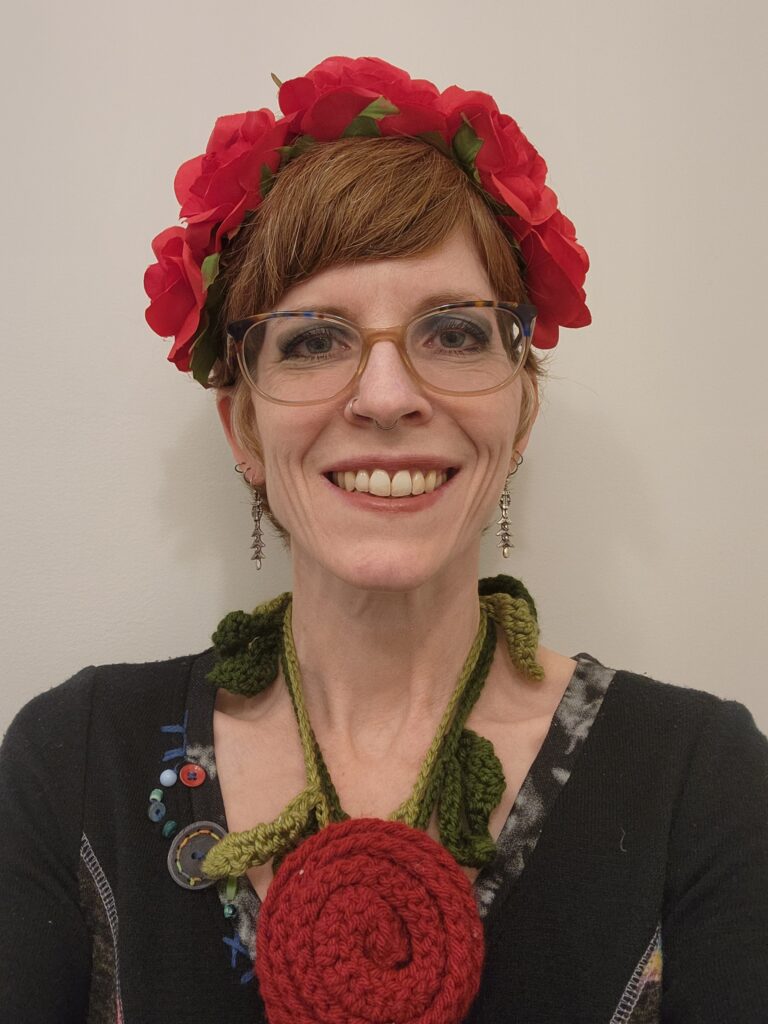
Morrow Dowdle (she/they) is the author of the chapbook Hardly (Bottlecap Press, 2024), the forthcoming chapbook Missing Woman (Charlotte Lit Press, 2026), and the forthcoming full-length collection Heartsick Requiem (Riot in Your Throat Press, 2026). She is a three-time Pushcart Prize nominee, and her work has been featured in journals such as Rattle, New York Quarterly, Southeast Review, Stonecoast Review, Pedestal Magazine, and others. She works as a freelance editor and is pursuing her creative writing MFA at Spalding University. She lives in Durham, NC with her two children.
Your poem “White Deer,” which is a featured PIPS poem, is packed full of beautiful imagery. What inspired this poem?
I live on the edge of the Eno River State Park in Durham, and our yard is full of wildlife. In the summer of 2024, shortly after moving into our house, we noticed a little white fawn with the usual group of does. Albino deer are extremely rare, and his presence felt a little like a blessing. Since then, we’ve been watching him fondly as he grows, and this year, his antlers are really starting to come in.
I noticed that in your poem “o doctor” you utilize open space within a line. You also utilize indentations in each line, giving a visual that the lines are flowing back and forth. What can you tell us about this typography and why you chose it for this poem?
This poem is about an actual experience I had with a family medicine physician when I was trying to figure out why my son was having persistent fatigue, weakness, and fevers. I wanted to convey the sense of feeling disjointed and overwhelmed as I dealt with my son’s illness, feeling alone as his doctor treated us with skepticism and disdain. My fear escalated in the context of his callous behavior–who would help us, if he wouldn’t? I am trained as a physician assistant, but my knowledge of medicine could only get us so far, as my son is my child and not my patient. I also liked the way the stanzas flowed like the snakes on a caduceus or a strand of DNA.
In what ways have your experience in the medical field informed your writing?
Morrow Dowdle
The opportunity to listen to so many patients’ stories over the years fed my lifelong love of narrative and deepened my capacity for compassion and empathy. I have almost never written about my patients’ particular lives, but their experiences certainly led to reflections about sociopolitical issues as well as my own existence. The nuance and intimacy of those exchanges fed the emotional intensity my poems tend to have.
Your book, Hardly, touches on themes of disordered eating. What is the main takeaway you want to leave readers with in regards to this theme?
Eating disorders are often a response to trauma and a need for control over one’s life, rather than the desire to look a certain way. The disease is tenacious, but recovery is possible.
You write in couplets in poems such as “Bones” and “Whiff of Spring”. How do you know when couplets will serve a particular poem?
When I first begin to write a poem, I put all of the sentences from my initial notes out on the page, so that I can begin to infer how they might work together. The adoption of couplets is often fairly straightforward–if a poem is reckoning with a relationship between two things, that two-line stanza form might serve it well.
What led to the creation of the Weave & Spin performance series? What have you enjoyed most about this series? What, if anything, has surprised you about the reading series?
In 2022, I identified in Orange County an absence of poetry readings featuring members of BIPOC and LGBTQIA+ communities, as well as younger literary artists. This demonstrated a gap both in community representation as well as performance opportunities for those in younger and historically underrepresented demographics. I wanted to create an event that could fill this gap. I have enjoyed bringing these voices to the community and providing them with well-deserved exposure. Many of them have been artists I personally admire, and the opportunity to see them perform was also a selfish pleasure! I loved having an open mic identified as a genuine “safe space,” particularly with my background as a mental healthcare provider. I was floored by how many open mic participants were reading their work for the first time in front of an audience, often courageous narratives around traumatic experience.
What do you like most about performing at readings? Is there a venue or space that you feel particularly drawn to for readings?
I am fairly shy and introverted by nature, and poetry readings force me out of that default. I did a little acting work as a young adult, and readings allow me to indulge in that performer part of me. I can feel myself shift into a different psychological space, and it’s typically a pleasurable experience, especially when my work evokes strong responses from the listeners, and I feel that sense of connection with the audience. I love to perform at small, atypical venues–a recent reading at Unlikely Professionals, an independent boutique in Raleigh, comes to mind. I also enjoy being invited to read for non-literary organizations, such as the Ethical Humanist Society of the Triangle in 2025.
You have said that you believe poetry is an important tool in the healing process. Can you speak more about how someone can go about implementing writing and poetry in their healing journey?
It is no surprise that so many therapists recommend journaling as a self-help technique to their clients. There is something about physically putting our thoughts and feelings on a page that can allow us to see our circumstances with greater clarity and objectivity, as well as provide a sense of relief and release. I know many poets, including myself, whose poetry grew initially out of a journaling practice. It’s not too far of a leap to add concision and other craft to an internal stream of consciousness and find art from the midst of that expulsion. Later, sharing that work with others, if the opportunity arises and feels right, can provide a powerful sense of connection and the feeling of being less alone with one’s suffering. Reading poets who write about trauma can also provoke empathy and inspiration–Dorianne Laux, Marie Howe, Danusha Laméris, and Gabrielle Calvocoressi, to name just a few.