
By Mary Maceda
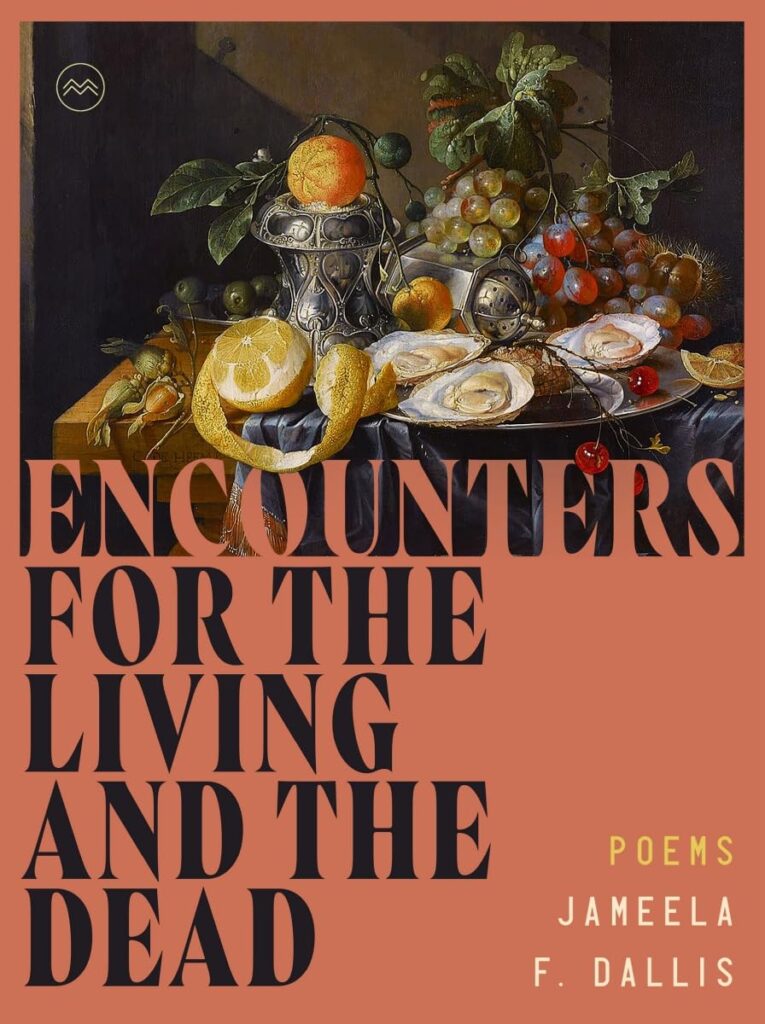
Jameela F. Dallis’s Encounters for the Living and the Dead (River River, 2025) explores the ways memory, love, grief, ancestry, and place remain intertwined across time. Throughout the collection, Dallis considers how the dead continue to shape the lives of those who remain. More importantly, she transforms witnessing from passive observation into an active form of remembrance. Through altars, food, photographs, landscapes, oceans, and what and who came before them. Her repeated declaration, “ I am witness,” becomes a critical lens for understanding the collection to witness is to remember, carry, and preserve.
The phrase “I am witness” repeats throughout “Black, holy time,” functioning as anaphora and establishing witnessing as the speaker’s central responsibility. The repetition gives the phrase a steady, declarative rhythm, emphasizing the speaker’s commitment to observing and caring for the voices and histories that surround her. Dallis writes, “ I am a witness. The portal is lined with voices: tongues from Babel, Georgia, Mississippi, Carolina, Tennessee, and mountain laurel growing toward light in Appalachian hills and holler”. These places are not simply a list of southern locations. By placing the speaker among the South’s landscapes, Dallis suggests that memory is embedded in geography. The poem gives the land an active presence, allowing the landscape to function almost as a keeper of ancestral voices and histories. This is where Dallis’s especially compelling witnessing becomes larger than personal memory and extends towards the histories held within the land itself.
That responsibility to remember continues in the collection’s first section, “Altarwork.” Dallis explains in her notes that these poems are written for people who have passed away, imagining them as part of an altar “thick with candles and melted wax.” The altar becomes more than a symbol of mourning. It becomes a ritual space where the living can maintain relationships with the dead. In “Valentine’s Day,” the speaker writes, “I keep your picture on my altar because you know that magic is currents in our blood and these currents come back form.” Dallis is effective here because memory is not presented as something static. Instead, it moves beneath the surface and returns through the body, blood, and ritual.
Another recurring symbol is the oyster, through which Dallis examines desire, vulnerability, and memory. In “My heart’s left foot,” she writes, “my heart rendered into oyster grilled and shellkept.” The heart becomes something protected yet still capable of absorbing and retaining what has happened to it. Later, the speaker describes herself as having “become a bitter thing “ after attempting to release the memory of a relationship. Dallis is especially effective in turning emotional vulnerability into something physical, a heart that can be protected, wounded, opened, dredged, and consumed. The image accumulates meaning throughout the collection, particularly as oysters appear alongside desire, water, hunger, and transformation. In “The Bounty of Occasion,” Dallis returns to the oyster in a different context, describing how the roasted oyster becomes associated with nourishment, family, and tradition, expanding its meaning beyond the vulnerability of the speaker’s heart.
Dallis’s use of sensory imagery is especially effective in “The Bounty of Occasion,” where family is experienced through food, music, touch, and conversation. She writes of a table prepared for “full-throated laughter and annual/embraces,” declaring, “this is family: found, chosen, and born into.”The poem fills the gathering with music, the scent of bourbon pecan pie, conversation, and a meal of “roasted oysters harvested the day before, golden she crab soup, and impossible rum cake.” These details show how family is experienced through shared food, music, touch, and conversation, with traditional recipes carrying memories and love from one generation to the next. The gathering also becomes ritualistic when Dallis writes that “there’s a place for the ancestor, a sacred setting rimmed in gold or red.” Family therefore includes both the living and the dead, making the dinner table another place where witnessing and remembrance occur.
The third section, ”Ekphrastic Encounters,” expands Dallis’s idea of witnessing beyond family and ancestry and into visual art. Dallis notes that many of the artworks referenced in the section are connected to the North Carolina Museum of Art and encourages readers to research the works or encounter them in person. This section strengthens the collection’s larger argument by showing that memory can also be encountered through art and public spaces. The poems move between personal experience and historical and visual works, inviting readers to become witnesses themselves.
Reading Encounters for the Living and the Dead left me thinking about how memory can keep relationships present even after people and moments have passed. What stayed with me most was Dallis’s idea of witnessing as an active responsibility. Her poems suggest that remembering is not simply looking backward. It is a way of carrying people, histories, traditions, and love forward. By the end of the collection, “I am witness” feels less like a declaration of observation and more like a promise: to see, to remember, and to refuse to let what came before disappear.
Jameela F. Dallis is a multidisciplinary writer, curator, art collector, and scholar based in Durham, NC. With experience in UX writing, academia, marketing and professional communications, arts journalism, and nonprofit organizations, she brings fresh perspectives and critical insights to strategy, design, and copy. Her first full-length poetry collection is Encounters for the Living and the Dead (River River Books, 2025). Jameela received her Ph.D. in English from the University of North Carolina at Chapel Hill in May 2016. Read more about her work at Jameeladallis.com and follow her on Instagram @Jameeladallis .