
By Rachel Barron
Poetry in Plain Sight started in 2013 with the goal of bringing poetry to more public places in North Carolina. The idea is simple: put poetry where people can encounter it unexpectedly in order to make poetry part of everyday life. Each year, 48 poems by North Carolina poets are selected for display in storefronts, libraries, bookstores and cafés. Past locations have included Asheville, Raleigh, Carrboro, and many more.
Last week, Poetry In Plain Sight opened for submissions. In celebration, we’d love to highlight Nicole Farmer, whose work was displayed as part of the 2025-2026 Poetry In Plain Sight Program.
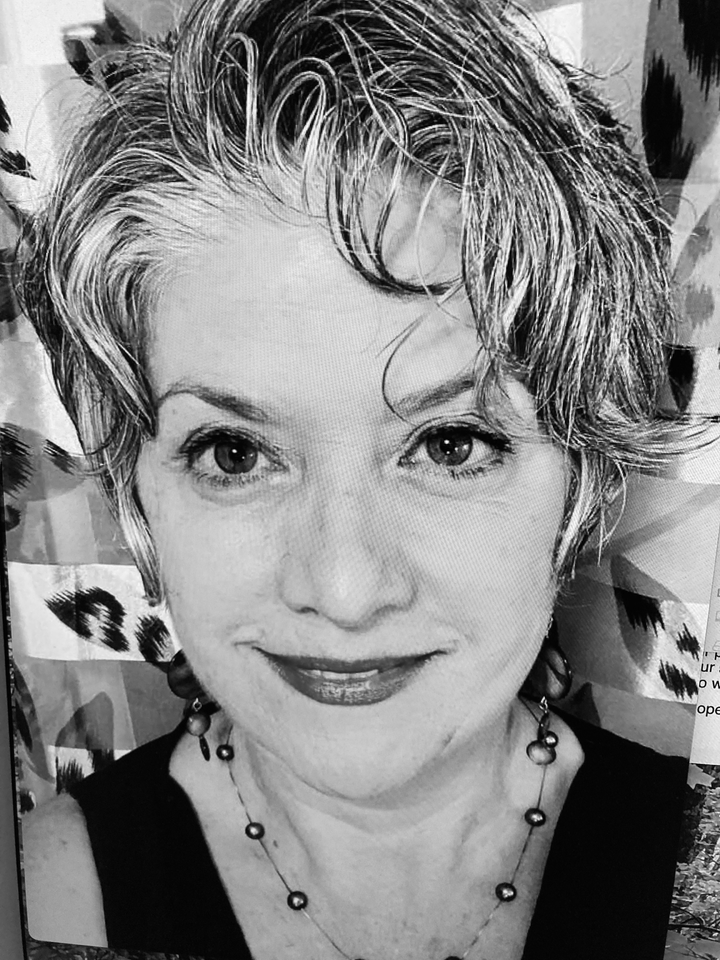
Nicole Farmer has published three books of poetry, Wet Underbelly Wind, Honest Sonnets, and Open Heart. Her memoir, My Life as a Dog, will be published in 2026. Her poems have been published in Wisconsin Review, Suisun Valley Review, Apricity, Wild Roof Journal, Poetry South, Kakalak, Laurel Review, SoFloPoJo, and other journals. When she’s not reading or gazing at the night sky you can find her at the Asheville Art Museum where she gets paid to contemplate fine art and remind people not to touch. Check out her website: NicoleFarmerpoetry.com
I recently read your poem “self-portrait with self-confidence” in The Great Smokies Review, and I thought it would be a fitting piece to begin our interview. Your imagery is especially vivid, particularly in lines like, “today I could fly around the moon / calculate the square root of contentment / let the light stream out of my eyes like the high beam of an old movie projector.” How do you develop such vivid imagery in your work?
I find that poetry often allows me to access the way I viewed the world as a child. I let my imagination go to a place of innocence where anything is possible and the boundaries of reality, or the reality we accept as real, fall away. This allows me to play and pretend that anything is possible, as it often is in our dreaming. I also keep a dream journal, and try to write down snippets of what I remember in the morning before I get involved with the chores and tasks of the day.
Your poetry often moves between memory and imagination. How do you know when a memory is ready to become a poem?
I am constantly generating ideas for poems as I travel through my day. This is why I carry small notebooks with me to jot down ideas or even a line that pops into my head. I usually write the poem when I’ve been thinking about it long enough that it MUST be written down. That’s sometimes a day or two or sometimes less than an hour. When I have written it out, (free form, stream of consciousness, usually in prose form) then I begin to type the lines and see what form might take shape on the page. I enjoy experimenting with form and usually have several versions before I settle on couplets, say, or a shape poem.
Speaking of readiness, what does the revision process look like for you? At what point do you know a poem is finished?
I used to be so hasty in sending out new poems. I am learning to let them sit longer, before I send them out to publishers. I find that putting them away and returning to them a few days later, or weeks later, brings a new perspective. I am fortunate to have a group of fellow poets here in Asheville with whom I can share new work and receive feedback. I’m a member of a poetry critique group, usually enrolled in a class, and have also started a monthly poetry book club with fellow writers. I am never sure when a poem is actually “done”. Even after they are published, I can usually think of some improvements or edits I wish I had thought of. Ha!
Your poem, “March” was published in our statewide Poetry In Plain Sight program. What kind of advantages do you think the North Carolina Poetry Society’s PIPS program can offer your poetry in comparison to traditionally printed publications?
I love the PIPS program! I think it’s really important in our digital world to have print material that kids in particular can read, and for people to see poetry in unexpected places. It’s wonderful to see someone at a restaurant, library, grocery store, stop on their way into the restroom, say, and read a poem. My favorite experience was hearing a kid read my poem “March” aloud to their family at The Hop in West Asheville as they ate an ice cream cone. They had no idea I was at the next table over. Then the family talked about Red Tail Hawks, one they had just seen earlier in the day, and how the poem is shaped like a bird. What a thrill! I was a Montessori teacher for many years, and also a first/second grade teacher in public schools in California and NC, and I still volunteer to help children learn to read. Nothing brings me greater happiness than reading! I think programs like PIPS help to increase literacy and the fun of reading.
Nicole Farmer
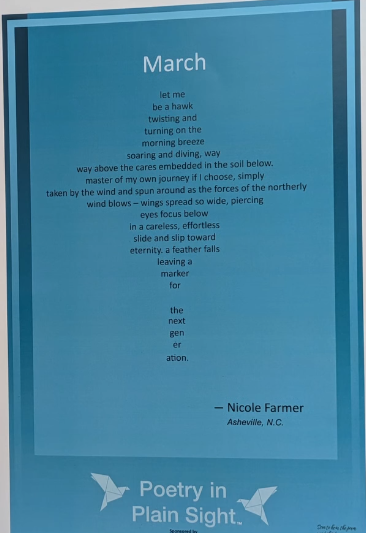
Again, “March” takes on such an interesting shape visually. How do you know when a poem should develop into a traditional form, prose, or shape poem?
I find shorter poems lend themselves to shapes better. Sometimes a poem’s shape appears when I am writing it, sometimes I deliberately try different forms. I wrote a series of shape poems while experimenting with “object poems”. It’s difficult to get literary magazines to publish them. Most smaller magazines don’t have the sophisticated printers required, and it’s a hassle for them. You see amazing shape poems all the time in Poetry Magazine, but they have the budget to be able to accommodate more experimental forms.
You moved more than thirteen times before the age of seventeen. How did a childhood defined by movement shape your poetic imagination?
When you are constantly moving, you learn to make friends quickly. You also learn about impermanence and your home becomes the people you love, not a house or a town. I was lucky to have two very loving and artistic parents who encouraged me to follow my desires into the arts. I spent thirty-eight years in the theatre as an actress and later as a director. I graduated from The Juilliard School in 1990 and had a long career on stage. I didn’t begin writing poetry until 2017 when my father died. I have been fortunate to have excellent teachers in California and in North Carolina who have helped me craft not only poems, but to encourage me to embark on a second career.
As a fellow resident of western North Carolina, I often find myself drawn to writing about the mountains and landscape of the western region of the state. Landscape also plays a significant role in your poetry; how does natural imagery influence your work, and what draws you back to certain landscapes?
I agree. The mountains are magical and I feel so lucky to live in them. I think loving nature is a part of being comfortable with solitude. Of cherishing the role of observer. Of embracing the role of silent witness of nature and animal life. I love visiting the ocean and hearing it roar, but I feel most at home in the quiet of a forest, with smells of moss, earth, leaf mold and mushrooms. Some of my best friends are trees.
As the author of three poetry collections and work published in more than forty literary magazines, when you look back to the beginning of your journey with poetry, how has your relationship to the art form changed since publishing your first collection?
My first book was published by Finishing Line press and that was an excellent small publishing house that requires the authors to pre-sell books. Since then I have worked with Kelsay Books, which makes none of those demands, and they are publishing my fourth poetry collection, My Life as a Dog: a Theatre Memoir in Haibun (to be released in winter 2026). I think my relationship to writing has changed since my first book in that I make bigger demands for excellence on myself. I want my work to reflect that my craft has grown and evolved and therefore I worry more about polishing the poems to their best version. Not perfection. I find that to strive for perfection will drive me crazy and often prohibits my creativity. Listening to my true voice and striving for excellence IS attainable.
What advice would you give a young poet just starting out?
Keep a journal. Travel. Experience other cultures and ways of living. Be a keen observer of the world around you. Write letters – real letters to people you love. Build a community of other writers you admire and respect, as they will often be your best editors and sounding boards for new writing. Love. Be fearless in your pursuit for truth. Take risks. Trust your instincts. Don’t let failure stop you, use it as the fuel you need to persist. Care less about the opinion of others.
Nicole Farmer
Ultimately, just write. Keep writing even when you are filled with doubt.
What is something that you feel that no one talks about?
I think artists (writers, poets, actors) are often afraid to talk with honesty to the public about how difficult it is to make a living. That’s why so many people give up. The only poets I know who make a living are those who choose to teach, and then the demands of academia leave them less time to write. My entire life as an artist I had to hold down a “day job” to support my artistic endeavors. I’ve worked in restaurants, retail stores, factories, clubs, bars, temp. jobs in offices, catering, as a nanny, as an educator, and currently at the Asheville Art Museum. I have never been able to earn a living as the well-trained actress I was, or currently as a poet. Most magazines don’t pay for the privilege of publishing my work. The books I publish are not big sellers like a best-selling novel. It’s a tragedy. Would I do it over? In a skinny minute! I love being an artist. It’s no longer a choice – it’s who I am. It’s the way I have found happiness. Is it a stressful and hand-to-mouth existence? You better believe it is!