
by Jackie Knowlton
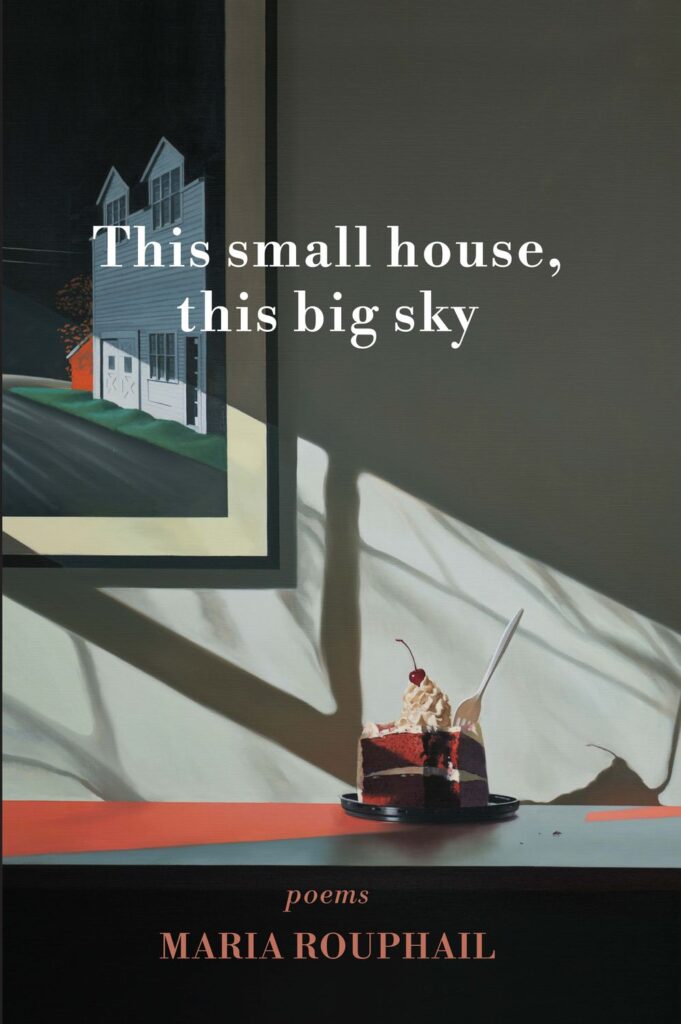
Maria Rouphail’s This small house, this big sky (Redhawk Publishing, 2025) was shortlisted in 2025 for the Roanoke Chowan Poetry Prize by the North Carolina Literary Review. The collection beautifully articulates themes of family, including the many dynamic roles within a family, such as the relationships to one’s grandparents, parents, and children. The collection also touches on themes of illness and the role of women in the church.
Rouphail discusses anxieties and fears surrounding motherhood, including her mother’s and her own fear of passing down a predisposition for breast cancer. In “Diagnosis,” she writes “Did I give you a body like mine? / Poor daughter! / It, too, will make orphans.”
Rouphail discusses the many pains and fears of motherhood and the things that fall outside of a parent’s control. This theme travels across time, with her poem “Pandemic, 1918,” depicting a mother’s feeling of helplessness in the face of disease. She writes, “she had no way to stop him,” referring to the influenza that took the mother’s baby.
Rouphail does not shy from talking about themes which give the reader glimpses of the complexities of motherhood. Spanning across history and her personal journey, Rouphail’s poetry addresses aspects of motherhood and aging, including her son’s growing up and moving away. She reflects on everyday interactions with strangers, such as having her fridge repaired by a man who reminds her of her son in “Appliance Repairman,” and seeing a woman in an airport who may have been the child who lay beside her in her hospital bed long ago. She travels back into the lives of women who were formative to the Roman Catholic Church and takes on their personas, including Mary Magdalene, Mary of Nazareth, Martha of Bethany, the Canaanite women, and the Samaritan women, showing that emotions of the female and human experience remain universal across time. She writes of Mary Magdalene, when she was grappling with the gossip surrounding her name, “How do they know I didn’t simply love him.” Here, she forms the thoughts of a woman who lived two thousand years ago in a way that readers can empathize with.
Rouphail creates a sense of relatability, not only through her subject matter, but also in the way she encourages readers to imagine scenes. She puts the reader directly in the room with her, giving them insight into what the narrators are thinking and feeling. She brings the women of the Bible, who are often viewed more as symbols than people, into full view, making them feel just as real as her contemporary narrators. In the second part of the poem “Five Women,” Rouphail describes Martha of Bethany’s feelings towards her sister: “I’d been cooking all day. But when he / said Let her be, as though she had / as much right as any man / at the table, I sat myself down. / Like my sister / I, too, burned with dreams.” This poem holds significant relevance for modern readers, as women around the world are met with the lingering expectations and constraints of gender roles and are left to decide how they will respond to them.
Rouphail goes on to explore her grief of her mother’s death employing journal entries and poems in which her mother appears to her in dreams. The dreams tend to end with a feeling of incompleteness. She wakes before she can answer her mother’s question about what she is dreaming in her first journal entry on page 7. In the poem “Seeing my mother from the pulpit of a church I don’t belong to,” Rouphail writes of a dream in which her mother comes to pick her up from a church she mistakenly finds herself in, but once outside, she can’t find her mother. “Maybe she’ll take me with her this time.” This recurrence of the theme of separation in dreams can be interpreted as a metaphor for grief and how the poet conceives of death. She is seen longing for her parents who have passed, knowing that she will follow them one day. She feels as though even when she feels close to them, she is plagued by the depth of their separation.
In the poem “To My Mother and Father” Rouphail writes, “If I am lucky, / God will give me / twenty years / before I meet you.” The poet acknowledges the realities of time, the way it separates people yet she remains grateful for her experiences and time with family.
Rouphail’s work does not merely depict hardship, but shows the nuances of life, how joy is held inside pain. In the poem “Things that lift my heart and make it glad,” she extends gratitude toward everyday happenings, including “midmorning tea, / mango-ginger, / in the white stoneware mug” and “a long walk through an old city / the sun waiting at the end of a street.”
She describes the home her son and daughter-in-law live in, where they make tea and listen to music, as well as the trees in front of the house. Moving outward from the lively interior of the house, Rouphail takes the reader outdoors to explore trees, tornadoes, and mountains. She writes of the scene from her airplane seat on a flight to Canada in “Toronto Travel Notes,” saying, “Earth puts on its day clothes-/mountains necklaced in cloud.”
Rouphail powerfully personifies natural elements throughout the collection. She describes a tornado in the voice of a child in the poem “A Young Child Speaks of a Tornado before dawn, Iowa City.” She describes the tornado’s aftermath: “all the trees looked sad” which calls to mind a child’s drawing. The childlike innocence achieved through the speaker’s voice is deeply effective in creating lasting images for the reader.
In This small house, this big sky the dominant theme is familial relations through the lens of time. Rouphail writes of a lineage that includes the unknowns of disease, moving, memories, and grief. While the specific circumstances surrounding these themes change with time, the feelings of a mother’s fear or the depths of grief for a loved one remain constant. By displaying a vast timeline, Rouphail shows readers that they are not alone in their feelings. She emphasizes the connected nature of family by showing a lineage of the things which remain constant in life: grief, fear, and love. She ultimately portrays the survival of stories through the personas and personal perspectives she takes on, showing the importance of historical and familial remembrance to feel connected to ourselves, each other, and the world around us.
Maria Rouphail, PhD, is Senior Lecturer Emerita from North Carolina State University, where she taught courses in World Literature and where she also served as an academic adviser to the English major. Poetry editor at The Main Street Rag, she has published three poetry collections: Apertures, Second Skin, and All the Way to China. Her first collection, Apertures, was a finalist in the New Women’s Voices competition at Finishing Line Press. Her third collection, All the Way to China, was a 2020 finalist in both the University of Wisconsin Brittingham Poetry and the Blue Light Press competitions. This small house, this big sky is her fourth poetry collection. A six-time Pushcart nominee, Rouphail served as the North Carolina Poetry Society’s Gilbert-Chappell Distinguished Poet for Central North Carolina in 2024-25, Rouphail lives in Raleigh.