by Mary Maceda
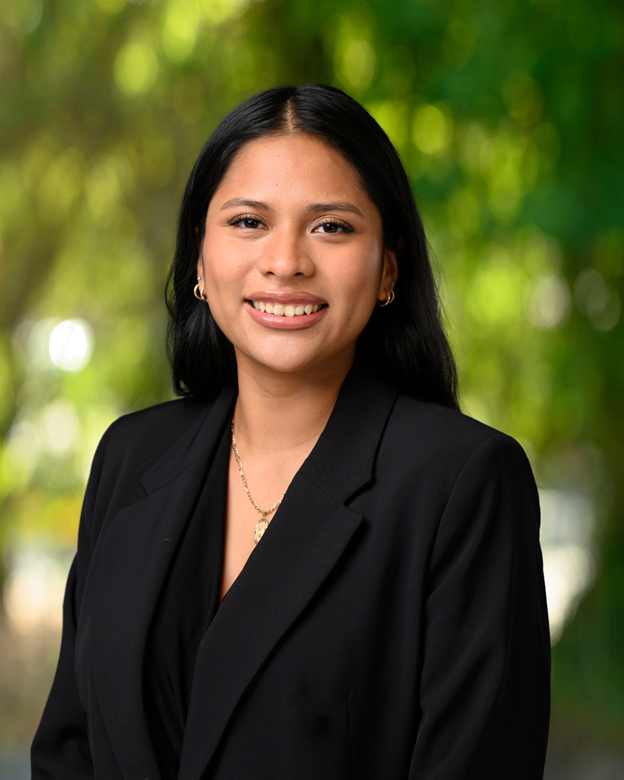
Kimberly Pelagio-Luis is a first-generation graduate student at the University of North Carolina at Pembroke, hailing from Santa Ana, CA. She earned her Master of Arts in Teaching degree in May of 2026 from the same institution where she received her Bachelor of Arts in Sociology degree in May of 2025. Kimberly was a student teacher that has been recognized repeatedly for her contributions to education, leadership, and advocacy. She was part of the Kappa Delta Pi National Professional Association and Honor Society for Educators, the Omicron Delta Kappa National Leadership Honor Society and the 1887 Honor Society at her Alma Mater. Kimberly held active leadership at her institution, serving as President of the Graduate Student Organization, Chief of Staff for Student Government Association, and as the Associate Vice President of Academic Affairs for the UNC Association of Student Government. Kimberly continues to give back to her community by volunteering with the Robeson County Teen Court program and the Southern Regional Model United Nations. She is also an avid researcher, who has completed research with the Santa Ana Unified School District–where she received her K-12 education–through the Education Justice Academy program and won an award for presenting her research at the UNC Pembroke Graduate Research Symposium. Although Kimberly is well-known for her leadership and advocacy, few know about her passion for poetry!
What motivated you to pursue a career in education, and how has your journey as a first-generation graduate student shaped that path?
I was motivated to pursue a career in education because of the impact that my educational journey has had on me. Growing up, I was fortunate to always have amazing and thoughtful educators throughout my K-12 education who stepped outside of their roles to help me in expanding my skills and applying to college. As a first-generation college student, I felt like I came into college “blindfolded,” and not knowing what to expect was a very difficult feeling to overcome. However, I felt greatly supported by the educators around me, not just the professors, but staff, administration and my fellow peers. As a first-generation college student, especially now that I have received my Master’s degree, I greatly value the impact of education and understand how important it is for me to go back into the classroom and teach the next generation but also represent my community and students proudly.
You hold several leadership roles as an educator, advocate, and student leader. How do you balance those responsibilities while still making time for your academic work and creative pursuits as a writer and poet?
There’s a saying that goes “if you do something you love you’ll never work a day in your life.” Every role I have held or currently hold was meaningful to me, it was more than just a “job” and more of a necessary part of my life. When you find something that you love doing, it’s very hard to not pour time and energy into it with any opportunity you have. As a first-generation Latina student, I have also never shied away from doing and experiencing everything I can, from being a CNA to being a teacher and office assistant, I have learned and loved in every position I have ever been in. Of course, there must always be a work-life balance, which I had to learn is very important. I always choose myself at the end of the day, because you cannot help others without helping yourself first.
How does your work in education and advocacy influence your voice as a poet?
My work in education and advocacy influences my life and decisions in more ways that I could imagine. Every day I am exposed to new viewpoints and learn new skills or knowledge. I am continuously inspired by the people I work with and those who came before me and “paved the way” so that I could succeed. Because my work is so intertwined with my life, it makes sense that it would greatly influence my voice as a poet, as I try to be honest and loud with my poetry. I’ve found that more recently, I’ve begun to write poetry in my native language which is Spanish. This change is a reflection of my promise to be more true to myself and proud of my heritage during these tough political times.
What does poetry allow you to express that other forms of leadership or scholarship may not?
Poetry allows me to be more free-flowing. Other forms of leadership require structure to get the work done. With scholarship, there’s always a goal or purpose to be met and therefore there are specific things that must be done. I love having structure, but I also love relaxing, sitting down on my computer or writing on paper. When I write poetry, all my thoughts and passions flow without restrictions and that is what poetry allows me to express.
In your poem “lowercase,” what do you want audiences to take away from it? What does the idea of “lowercase” represent in the poem?
My poem “lowercase” is about the love that exists everywhere for all of us, whether that be in the form of a friend, a family member, a partner, a mentor, a classmate, a coworker, a pet, etc. There is always love to be felt and given, even during our toughest moments we are never truly alone. I think people expect to find love in loud moments, in uppercase writing, just like it’s portrayed in movies. Sometimes, love is like that, but most of the time, love is quiet, calm, and in “lowercase.”
Did “lowercase” evolve significantly from its original draft? If so, how did the poem change throughout your revision process? And, if this was the poem you developed with Gideon through the GCDPS mentorship, how did his input help shape or strengthen the final version of the piece?
Yes and no! “lowercase” was originally written primarily in English with one line in Spanish. When Gideon first read the poem, he loved it and suggested I write an “opposite version” which is where the second part came in. The second part of “lowercase” is the same as the first part, except it’s primarily written in Spanish, with one line in English. Gideon’s mentorship has truly expanded my way of looking at my poems. He has come up with poetry prompts that truly represent my personality and has helped me to make the most out of existing poems!
What message do you hope resonates most strongly with your audience?
I hope that people learn to love and appreciate it more than they currently do. I am fortunate to have had a loving family growing up, a loving group of friends to experience life with, and a loving partner to ground me. But I didn’t always think that way, there were times where I thought there was no love in my life and even looking back at memories made it seem like life was loveless. It wasn’t until I truly learned to love myself, that I was able to truly love others and in turn fell their love to the fullest. I was stuck trying to find “loud” love when love was always with me all along. So I hope that when people read my poem, “lowercase,” they feel the love I wrote it with and begin to feel the love in their lives as well.
Looking toward 2026 and beyond, what goals or aspirations are you currently working toward, and how has the GCDPS mentorship supported your growth as a writer, leader, and educator? Additionally, where can audiences follow your work and continue to support your journey?
I hope to begin my own non-profit organization! I’m not quite sure what specifically I’d like to target yet, but I do know it will be a reflection of all my lived experiences. The GCDPS and NCPS have inspired me to take my passions further and expand my reach through non-profit work in the field of education and advocacy. For the next school year, I will take a break from school, begin teaching and focus on the creation of my non-profit organization. If people want to keep up with my journey, I’d most likely be posting about this on my instagram: k.kimberrrly
As you continue your journey as an educator, leader, and poet, what legacy do you hope your voice leaves behind?
I hope to create educational opportunities for all. Education is at the basis of success and forward-thinking change. I hope to create a legacy that is more than just “voice” and more about “action.” I want people to know me as someone who brought her ideas to life and created spaces where others could succeed as well. I also hope to inspire others to be more meaningful in their work and proud of their contributions.
As a bilingual writer, how does writing in multiple languages shape your creative process and the way you express emotion or meaning in your poetry? Do you translate your own work, and when you begin writing, do you already know which language the poem will emerge in, or does that depend on the subject and emotion behind the piece?
I translate my own work, but I also double check for words I’m unsure of! Writing in multiple languages helps me have a clearer understanding of my poetry. I usually think in both of my languages, so it would make sense that when writing I feel compelled to write in both languages. I do think that when writing in Spanish, I am more inclined to write about love than when writing in English. I also usually write about topics I feel strongly about in Spanish as that is the language I grew up with and fuels my “fighting” voice.