
An insightful and informative conversation with Sienna Morgan, founding editor of BIPOCRYPHA Magazine
by Jackie Knowlton
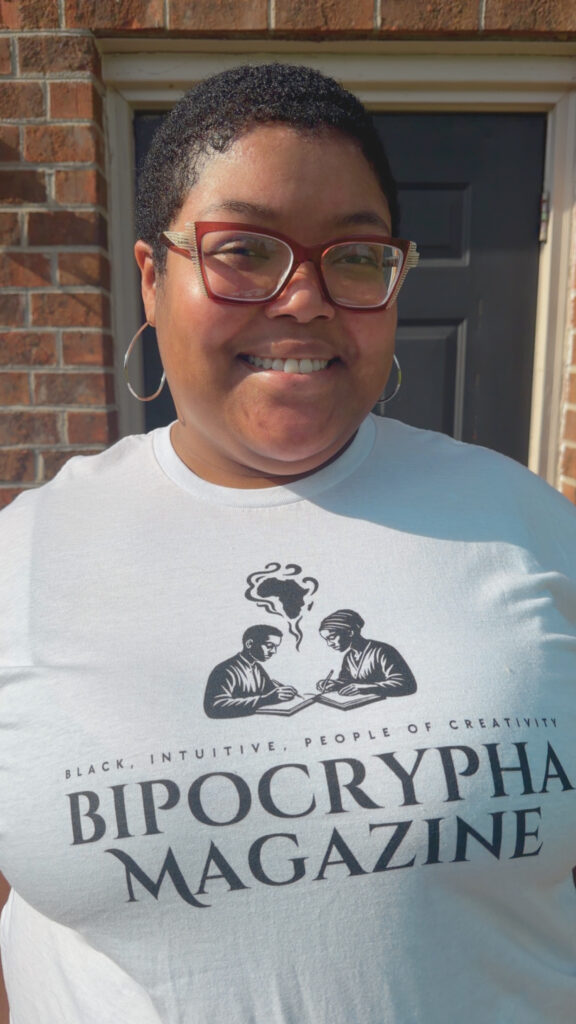
Sienna Morgan is a literary artist from Rocky Mount, North Carolina. Guided by intuition and spiritual inquiry, her creative practice moves at the intersection of faith, family, and fine art. Through poetry, short fiction, and essays, she explores interior landscapes, personal mythologies, and the quiet power of individual narrative. Her work has appeared or is forthcoming in Colorism Healing, The Black Light Project, Black Oak Society Magazine, midnight & indigo, The Arrow: A Journal of Wakeful Society, Culture & Politics, North Carolina Poetry Society, Black Disability Institute (BDI), and Kinsman Quarterly. She is the Founding Editor of BIPOCRYPHA Magazine, a space devoted to celebrating Black spiritual expression and creativity.
Learn More: Website, Instagram, Substack, support t-shirt campaign, email: bipocrypha@gmail.com
In this interview, Sienna Morgan discusses her religious roots and the importance of opening a space that explores the deep history of African American literature and the ways it intersects faith and spirituality. She speaks about the ways that spirituality has become a source of hope and community for the Black community and how it is an ongoing story throughout history. Morgan founded BIPOCRYPHA Magazine to create a space for Black writers to speak about their experiences with spirituality, something that is often misunderstood or neglected within literature. Morgan started this project alongside her fellow creatives, Brittany Morgan Armstead and Shainah M. Andrews. The inaugural issue will be released this October!
Below is a sneak peek at the interview. For the full text, look for the Summer 2026 Pine Whispers in your mailbox toward the end of August. Pine Whispers is mailed to all members. If you’re not yet a member and would like to be, please see our Membership Page.
This publication centers largely around the experiences of African American spiritual and religious traditions. What inspired you to focus on this theme in the publication?
Black individuals frequently find that their racial identity and religious identity are intertwined, creating a unique and powerful connection between our faith and our lived experiences. While not all Black people share the same religious beliefs, there is a powerful spiritual impulse that has shaped our histories, traditions, and creative expressions. Through the history of the African diaspora, especially the experiences of enslaved people during the Transatlantic Slave Trade, we see how spirituality became a source of hope, resistance, healing, and community. BIPOCRYPHA seeks to honor that legacy while exploring the many ways Black artists continue to engage with faith, ritual, ancestry, and the sacred today.
For the inaugural issue, Sound and Spirit, how did you filter the selection process to highlight its themes of faith, resilience, and hope?
For Sound and Spirit, we approached the selection process by looking for work that engages with faith, resilience, and hope in thoughtful and unexpected ways. While the issue is inspired by the tradition of African American spirituals and the ways Black music has carried stories of survival, resistance, and belief across generations, we did not limit submissions to one expression of spirituality.
What are you looking for in poetry submissions specifically? What elements catch your eye as an editor: typography, form, figuration, etc.?
Speaking only for myself as one-third of the BIPOCRYPHA masthead, I value tradition and clarity on the page. I’m drawn to poetry that allows the language itself to take center stage, so I often appreciate a clean, intentional presentation that keeps the focus on the words and the emotional or intellectual experience of the poem.
What hooks you into a submission and makes you want to keep reading?
What hooks me into a submission is a strong sense of voice. I want to feel that the writer has entered the piece with intention and that there is a distinct perspective guiding the work. Whether through a striking image, an unexpected turn of phrase, or an emotional truth that feels deeply lived, I’m drawn to writing that invites curiosity and makes me want to spend more time with the world the writer has created.
Writers, Jupiter Hammon and Phyllis Wheatley appear on BIPOCRYPHA’s logo. What do these writers represent within the overall spirit of the publication? What values do they highlight?
Jupiter Hammon and Phyllis Wheatley represent the literary and spiritual foundation upon which BIPOCRYPHA is built. As the earliest published African American writers, they remind us that Black literature did not begin in the Harlem Renaissance or the Civil Rights Movement—it began much earlier, in voices that insisted on creating beauty, faith, and intellectual life despite the conditions of enslavement.
For me, they also embody the questions that BIPOCRYPHA asks of every issue: What has been forgotten? What has been misunderstood? Whose stories remain hidden in plain sight? Both Hammon and Wheatley wrote from deeply spiritual worldviews, yet discussions of their work often reduce them to historical curiosities or flatten the complexity of their faith. BIPOCRYPHA is interested in recovering that complexity—not only in their writing, but in the work of contemporary Black artists whose relationships to spirituality, ritual, ancestry, and the sacred continue to shape their creative lives.
The values they represent are remembrance, reverence, artistic excellence, and historical continuity. They remind us that every generation of Black writers inherits a tradition while also expanding it. By placing Hammon and Wheatley at the center of our logo, we’re acknowledging that our contributors are part of a lineage that stretches across centuries. BIPOCRYPHA isn’t simply publishing new work; it’s participating in an ongoing conversation about Black creativity, spiritual imagination, and literary history.
What do you want North Carolina Poetry Society members to know about BIPOCRYPHA and sending their work to you? Do you have any particular North Carolina themes or places you would especially welcome work around?
While the submission window for the annual magazine has passed, be on the lookout for the drop of our inaugural digital issue which releases on October 17, 2026, on our website!! A call for submissions for issue 2 will be announced in the months following the release of issue 1. In the interim, we’ve launched our newsletter, BIPOCRYPHA Bulletin, on Substack, where we have a NO deadline call for submissions for personal essays that explore spirituality in Black artistry. We posed the questions: How has faith, ritual, ancestry, or the sacred shaped your creative life? Where does your artistic practice and spiritual journey meet? We welcome reflective, vulnerable, and thought-provoking personal essays that examine the many ways Black artists/writers encounter the divine, the mysterious, and the deeply human through creative expression. Newsletter submissions are selected on a rolling basis. Guidelines can be found here: https://bipocrypha.substack.com/p/newsletter-submissions