
by Rachel Barron
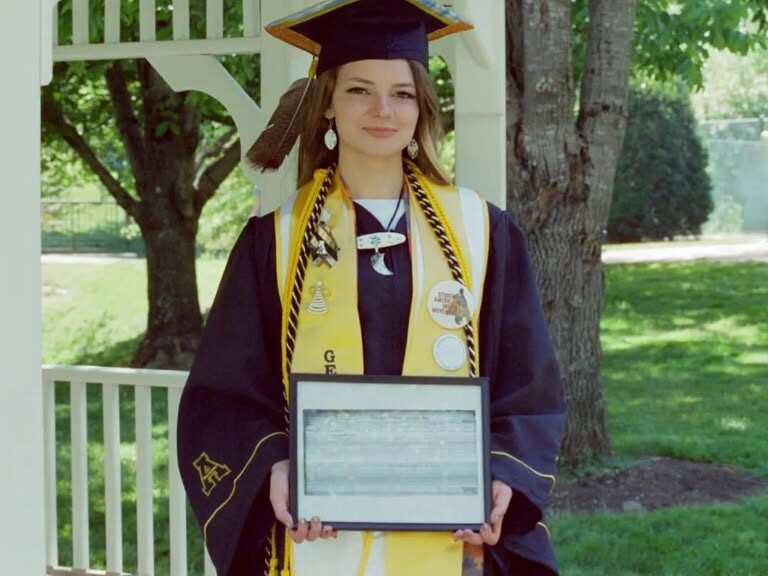
For Charlotte Isenberg, there is no “standard” way of self-expression in poetry. Working with her mentor, Lee Stockdale, in the western region of North Carolina helped affirm her original instinct: poetry is not a uniform genre. Rather, poetry is a means of self-expression without boundaries.
Charlotte Isenberg majored in Rhetoric and Technical Writing major at Appalachian State, where she graduated this spring. As a Tsalagi (Cherokee) activist and founder of the Abortion Doula Collective at her college, she writes about identity and her lived experiences to create a more just world. Looking forward to graduate school, she envisions a future of reproductive sovereignty for every rez, every holler, and everywhere in between. Find her on Instagram. As a graduate of the Gilbert-Chappell Distinguished Poet Series, we thank Charlotte Isenberg for sharing insight into the program, and we are excited to see what next she accomplishes!
This growing confidence in her own artistic voice is exactly what the Gilbert-Chappell Distinguished Poet Series is designed to foster. The mentorship program exists to support young and emerging poets like Isenberg to develop their craft by working closely with mentors, gain experience reading at events, and get a chance to publish poetry in the annual publication Witness: From Appalachia to Hatteras.
In this interview, she shares her thoughts on writing, poetry, life, and mentorship with Lee Stockdale through the Gilbert-Chappell Distinguished Poet Mentorship Program.
I had the pleasure of witnessing you reading some of your newest work at the Gilbert-Chappell event at the Spring Literature Festival on campus at Western Carolina University, and I must say your reading was striking, erupting with raw emotion, even angry at times. What stylistic choices do you make when reading out loud, and how do you intend those decisions to make your audience feel?
I try to read like I’m talking to someone I already know. I don’t write my poetry to perform it, which is probably anathema, and I think my more natural approach is the best way to express my work verbally because that’s how I try to make it come across on paper. I want, more than anything, for people to understand that I’m telling each of them as individuals about a real thing that happened to me or to my community.
When you think about the role of community among writers, how has being part of the Gilbert-Chappell Distinguished Poet Series shaped your growth as a poet?
It allowed me to feel more confident in my artistic voice. I used to be insecure about how I’ve never actually studied creative writing, which contributes to my lack of adherence to a specific genre or structure across my work. However, talking to other poets like Lee, who have done so many things outside of poetry, helped me see that there is no “standard” way of self-expression.
How would you describe your writing style? What themes or ideas do you find yourself most frequently coming back to?
I always come back to the ways our past informs the present and how, in that sense, it’s always being relived. I think a lot of my work is a way for me to relive my experiences and the experiences of my family in a way that creates good meaning out of something that can feel very messy when it’s stuck in my head. Seeing other people relate to and heal with it alongside me has been really incredible.
What is one unexpected thing that your mentorship with Lee Stockdale has taught you about writing or life?
I haven’t always been great with talking candidly about my feelings, but poetry sort of necessitates that, and Lee helped me understand how to do that through reading as well as writing.
First of all, thank you for sharing with me a copy of “I Went to Rehab and All I Got Was This Copy of The Lone Ranger and Tonto Fistfight in Heaven.” Such a fantastic title by the way, but I think my favorite moment in this poem is that, in the midst of such dark reflections on family and cultural trauma, eventually “the valley flattens to a plain.” Did you intend this work to have a kind of message of hope interwoven in?
Absolutely. I think when people hear about things like going to rehab or about the sort of generational trauma that comes with being Indigenous, which this poem touches on, they naturally assume it’s all just a tragic story. I wanted to be honest about how hard these things are while also showing how, ultimately, these are stories of hope and reconciliation.
Who are some of your biggest influences both within the world of poetry and in the arts more broadly?
Joy Harjo Joy Harjo Joy Harjo. I had the privilege of hearing her read a few months ago and was blown away. However, I will say that my favorite poem of all time is “The Wasteland” by T.S. Eliot, which Blood Root obviously references throughout. I am always blown away by poets who can create so many layers of meaning, and I strive for that in my more traditional poetry.
In your poem, “Blood Root,” I love the way you weave the Cherokee language throughout, almost as a raw expression of something beyond the limits of the English language. Would you say that is an accurate observation, and do you ever find yourself frustrated by the limitations of the English language?
I actually don’t speak Cherokee, and that’s something I struggle with pretty often. I use one of the handful of words I do know, wado, in “Blood Root”, and it means thank you. Weaving it with lines from “The Wasteland” (“My people humble people who expect nothing”), I wanted to comment on how colonization alienates Native people from ourselves and those around us, especially in things like traditional language, and how I often feel that I’m expected to be grateful for what I have been given with colonial artifacts like English.
Again, with “Blood Root,” you make such nice use of sound with descriptions like “snapping shut, rocking, shrinking, until you were only a shirt I held up to my face”; is sound something you think about a lot when drafting a poem?
I think poetry is a lot like singing a song or telling a story in the oral tradition (I know, not exactly a profound insight), but that’s what leads me to put emphasis on sounds. Those are what make words stick. I always hope they can flow mentally the way a song would when sung aloud.
Advocacy plays a significant role in your work, both with the Cherokee Nation and as the founder and lead organizer of the Appalachian State Abortion Doula Collective, but I’d like to understand more how it impacts your writing. How do these roles of leadership and activism shape your approach to writing poetry?
I realized early on that my writing is often perceived as a representation of the groups I belong to, for better or for worse, and I take a lot of pride as well as responsibility in making sure that I can properly advocate for the communities I work with every day through my creative endeavors. I know that, statistically, the thing that makes people change their minds about issues like abortion access is being emotionally moved by hearing someone’s personal experiences with that issue, so I hope to show people what life has been like for me through my poetry to illustrate the reasons we need to work for a more just world.