by Angie Horne
We thank Caroline for her Poetry in Plain Sight poems and for taking the time to share her stories behind them with intern Angie Horne. Caroline describes what community means for writers and why it’s so impactful. Read on for a sneak peek at her most recent PIPS poem, “Feast for the Eyes”, coming to a bookstore, cafe, or library near you in July.
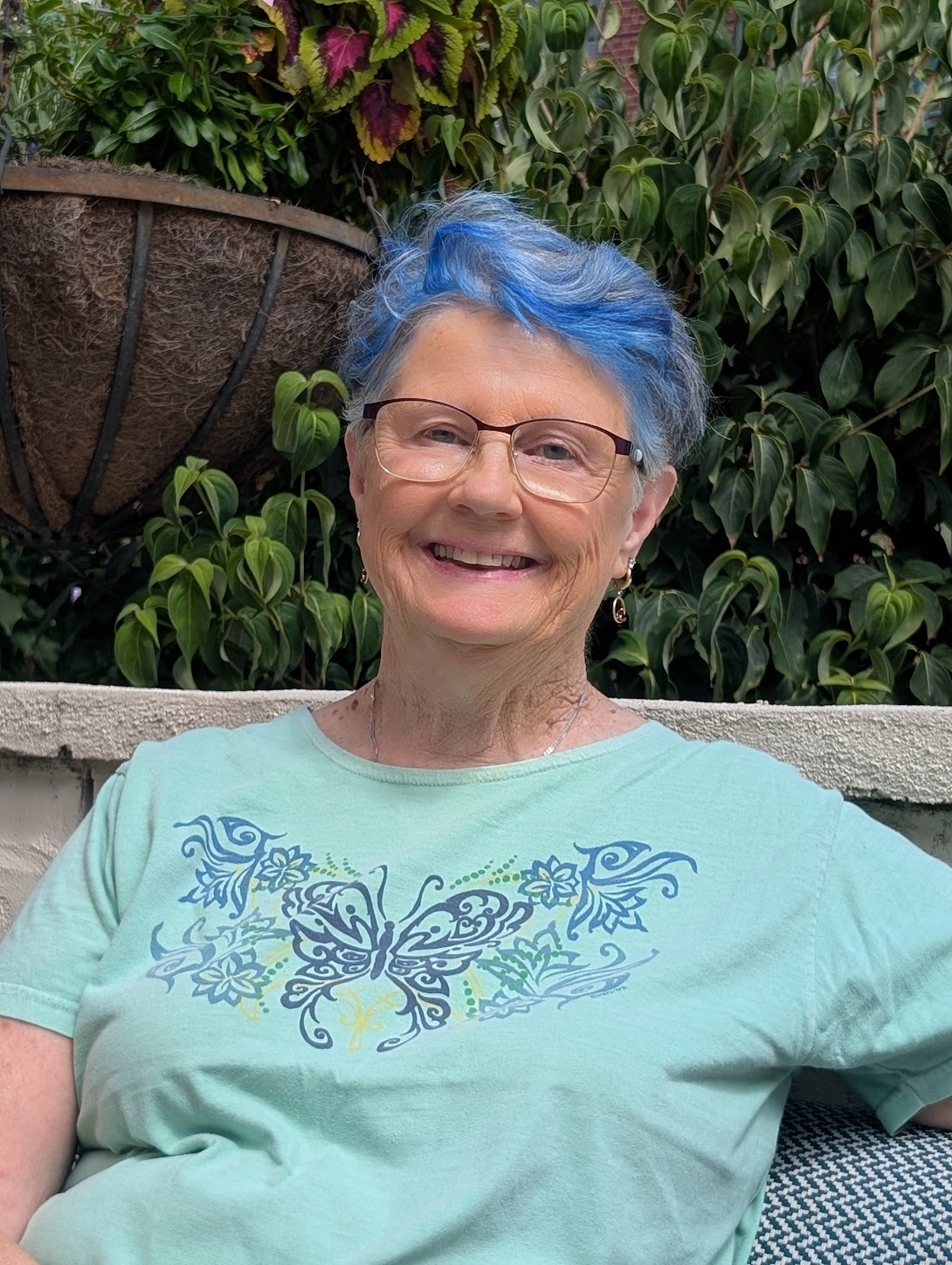
Caroline Kane Kenna of Huntersville, N.C. Her work has placed in Charlotte Writers Club contests. Poems in Above the Fold and various Kakalak anthologies. Essays in Foolhardy (Personal Story Publishing Project Fall, 2024), Reflections on the New River and Love of Baseball (McFarland 2015 & 2017); a former Charlotte Writers Club president. Her debut chapbook, Keep Your Damn Seat, was published in March of 2026.
How has your past as a newspaper reporter and daughter of writers influenced your poetic style?
I think my collage-storytelling, is an off-shoot of both nature and nurture. As a reporter, learned to pay attention to the facts, choose details that make scenes come to life. Tiny details I picked up listening to my parents swap stories at the dinner table. Parents who loved words and wordplay. Their first joint purchase was an unabridged dictionary that sat open in Dad’s office. We four were all encouraged to use it early and often.
You grew up in Virginia, spent time in the Midwest, and now reside in North Carolina. How do you think your peripatetic lifestyle has affected your love of writing and combining styles?
Writing gave me a way to claim “me time” in those trailing spouse/stay-at-home Mom years. It also gave me a connection in each new community. Once I found other writers I began to think of each stop as home. Now it is like bones and fingernails and skin. I can’t imagine what I’d do without writing time and I can’t imagine going more than a couple of days without parsing another verse, turning it into the next next line and the next.
What lingers with me from your poetry is a certain sense of detail that is very unique. Has this attention to detail always been an aspect of your writing, and how does it connect to your worldview?
Yes, poetically, I lean hard into images and metaphors. One of my first poetry sessions was on ekphrastic poetry, so I write a lot with piece of art and photographs as prompts. When I am in “poem”, it often begins with an image and as I write into that image, I let my imagination lead and it feels like everything I see, hear and experience seems to contribute to or inform the work in progress. I’d like to think that in poetry, my images are local, but the metaphor is global. I strive to pay attention to the world because there are unique images everywhere and poems are waiting to be discovered.
Let’s talk about Above the Fold. What was your most memorable experience from writing that anthology? How did the collaboration shine through the pieces?
Two of my fondest memories: finding the perfect cover art–for the anthology and theme and sitting at Tom Perkins’s dining room table, sipping tea and debating the order of poems for each section. Above the Fold, (Main Street Rag Publishing) was the first time I ever felt like my writing was a part of something truly unique. The five of us, Lynn Dausmann, Barbara Eckroad, Tom Perkins and Sandra Phillips and I, met weekly at Barnes and Noble in Huntersville. The idea for the anthology started with a free-write on fabric, a sort of Algonquin table, coffee and danish instead of three martini lunches. We wrote ourselves into a lasting friendship and an anthology. Each step, a collaboration and an education from how to order the poems to title and section titles, to which publisher to use, a group effort from beginning to end.
You often describe your profession as a “newspaper reporter before the internet”. Tell me, how do you perceive the internet’s effect on your writing, and the future of writing and poetry?
That phrase “a newspaper reporter before the internet” is better, in my opinion, than a writer of a certain stage–the crone but don’t ask her age. The internet is a magic carpet ride above the wild west train-nothing stops it. A world of information, factual and not, healing and raw punishing, if you want it, it’s there at your fingertips– a resource to be plundered and an unabridged dictionary to be searched. It prompts and enriches the intent of a poem maybe it broadcasts more poetry and broadens and deepens its appeal.
You seem to hold a love for collaboration between writers, being one of six in Above the Fold and the former president of the Charlotte Writers Club. What has made you particularly drawn to collaborating with other writers, and what are your tips on how this could benefit our readers?
Writers need connection and community. That collective energy gain is electric. I wrote alone in Illinois, in Indiana, with a small group of women focused on mining our stories–getting them on the page and sharing with each other. When we moved to NC, I found Barbara Kidd Lawing’s writing circle, poetry, my people and a new purpose with Charlotte Writers Club followed. I believe poetry is best when shared, one poet incites the next and before you know it there is a big ‘ol word cloud over your head in need of a good critique group to make it shine. Feedback helps guide revision. Advice? Trust your gut, but listen to the feedback, those suggestions are not made to be mean, but to draw attention to something that may not be clear as it could or should be. Often, I freewrite on feedback I disagree with, honoring that process changes perspective and opens the door for lines I hadn’t thought of and that brings fresh energy to the work.
Keep Your Damn Seat is your debut chapbook, and already it is a major hit. Describe to me your process while writing this book and identifying the important memories and themes. What drew you to produce a chapbook?
Honestly, having a book in my hand was on my wish list. Thanks to the Kakalak editors, and Above the Fold anthologies, and NC Poetry Society (PIPS) I have had enough publishing success to make me dangerous, to make me want my own collection. When a friend said something about not getting any younger, I decided to enter the 2025 Finishing Line Press chapbook contest. At the very least, I’d have a manuscript to submit elsewhere. But much to my surprise, my utter delight, FLP saw it differently and here we are. As I read the poems, I realize home is at the heart of the chapbook that speaks to the stages of my life thus far. I am over the moon about this solo project and thrilled by how well the cover painting, Little Birds, by Chris Arvidson mirrors the words in the book, I hope it starts many conversations. I hope there’s more to come.
Your Poetry in Plain Sight poem “You Would Have Thought It Ming”, recently on display in the Oberlin Regional Library, describes a grandfather’s gift, transcending years of holidays and leading to a lingering line: “Dad halved it with Mama; offered us the seed.” What was your inspiration for this poem, and how does this last line resonate with you?
Like most of my poems, this one started with a prompt–fruit or vegetable. As I wrote the avocado turned into Dad’s words “alligator pear”–morphed from food into the Christmas orchard boxes arriving in the mail. As for the last line, since I see poetry as a conversation between writer and reader, perhaps the seed and salt are my hope that this memory sparks others– as a child I didn’t like the texture of an avocado but that seed was a miracle, Just add water and my siblings and I loved to watch it change from roots to plant.
Recently, your poem “Feast for the Eyes” was selected in Poetry in Plain Sight, and it is truly a magnificent journey through a sunrise on a new day and a changed future. Tell me about the memory that inspired this piece. What is the message that you want readers to leave with?
I wrote this as my sisters and I prepared to sell the family place. On one of those last weekends in the house alone after my brother Tom had passed away, I made coffee, sat on the porch that he loved and watched the sun above the mountain turn the windows red. It felt like the house on the threshold of a new life was saying goodbye to this old one, a memory, the house and my brother wanted me to keep.