By Liz Maceda
Amanda Conover, Poetry Editor for Carolina Muse, answered our intern Liz’s questions over email. Be sure to check out the most recent issue of Carolina Muse and celebrate some local North Carolina (and South Carolina) writers, singers, dancers, and artists. Thank you, Amanda, for the generous discussion of craft, spirituality, representation, and more.
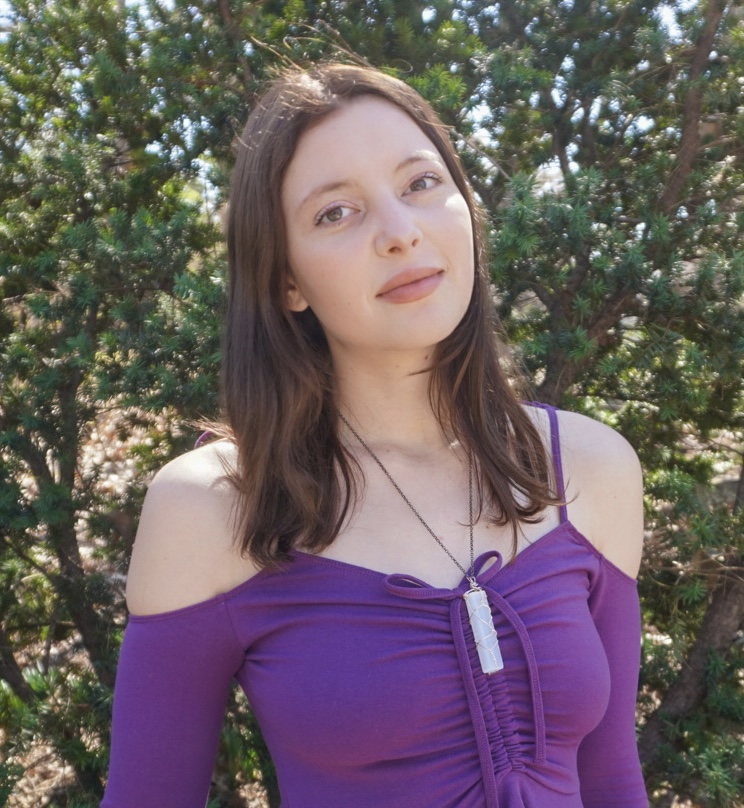
Amanda Conover writes poetry that is often surreal-leaning, mystical, and confessional. She is the Poetry Editor for Carolina Muse Literary & Arts Magazine and holds an MFA from Arcadia University. Her poems appear or are forthcoming in Atlanta Review, Glass: A Journal of Poetry, Lumina Journal, Witches Magazine, and elsewhere. Outside of poetry, she works as an editor in scholarly publishing and loves hiking in National Parks, traveling, and attending raves. Find her at www.amandaconover.com or on Instagram @amandamconover.
On your YouTube channel @amandaconover, you mentioned your interest in exploring various genres. How has this practice improved your poetry?
Being curious and open to an exploration of various genres and styles has helped my poetry in so many ways. It has inspired me and influenced my writing techniques, taught me the power of experimentation and play within different forms, and solidified my sense of voice and poetic power. It’s also helped me better realize all of the possibilities out there and how I want to fit my own unique experiences and writing strengths into the existing literary landscape.
How does your spiritual life shape your poetic voice? Do you find certain poetic forms better suited to spiritual expression?
Infusing my spiritual practice into my poetry has helped me channel a different kind of voice that feels more certain, more curious, and more free to try new things and really expand creatively. Voice, for me, is an ever-evolving thing, and the freedom to experiment with spiritual tools such as automatic writing has been a game-changer in opening up new pathways with my poetry. Form is such a tricky thing. I usually try to let a poem form itself. As a poem deepens into itself and reveals what it wants to say, the form usually appears naturally to complement the essence of the poem. I think any form can work for spiritual expression, depending on what type of expression, ideas, and themes the work deals with.
In your video “How poetry can change your life,” you discuss the value of creative writing. Why do you believe it is important to build healthy coping mechanisms through this medium?
I believe that there are many healthy coping mechanisms out there, and creative writing is just one of them. For me, writing has been instrumental in finding stability in a complicated world, processing things emotionally, and growing as a person. As someone who works full-time in scholarly research, I am really interested in journals researching the effects of writing, such as the Journal of Poetry Therapy. It’s still an emerging field, but much of the research so far seems to show promise in terms of the link between creative writing and skills like emotional regulation, community-building, and healing. Different mediums will work better for different people, but the most important aspect is having some kind of effective outlet.
You’ve noted that “poetry is inherently spiritual.” What does a poet risk losing if they write poems they do not feel a strong connection to?
Not everyone views poetry this way, but for me, describing poetry as spiritual is one of the closest ways to encapsulate the magic and beauty of the craft, as it’s often a difficult genre to fully define, grasp, or box in. I will say, writing poems without feeling a strong connection isn’t necessarily a bad thing. A lot of the time, when I am experimenting with a new form or idea, I am not in the state of absolute flow or connection. However, a long-term lack of connection to the craft can hinder the seemingly (or maybe actual) magical effects of a poem. Leaning into what you love and are drawn towards, rather than forcing yourself to consistently stick to certain themes or forms that you aren’t feeling connected to, can create a pathway for the strongest version of a poem to emerge. I think one might risk their level of devotion to poetry and some of the joy and love that is found in a deeply connected, spiritual writing practice.
How does being queer impact your poetry, and why do you think representation is important in this field?
Discovering that I was bisexual in college is what initially opened the floodgates and allowed me to explore writing and alternate forms of expression, interests, and hobbies. Being queer, and the process of deconstructing who you thought you were and reconstructing a sense of self that doesn’t align with societal norms, can be difficult, but it also provides a type of freedom and creativity that feels limitless. Some of those elements that I found from being queer have made it into my poems in the sense that I am very open-minded to trying out new things in my writing and deconstructing and reconstructing my practice, my habits, and my ideas. Representation is important because it adds diversity and innovation to the field. For so long, old white men were seen as the pinnacle of poetry (though there have always been diverse poets) and were given the majority of the credit. The more representation there is, for all groups and marginalized people, the less that kind of stuff happens and the more we collectively create a space where every voice is welcome and celebrated. Diversity enhances ideas and styles, and allows for more progress in the poetic space.
Beyond genre-blending, why do you think it is important to explore creative outlets like journaling and poetry?
Creative outlets like journaling and poetry provide a safe space for emotional processing, regulation, and discovery. Creativity has so many benefits, many of which are proven by science—from grounding oneself to decreased stress to better brain functioning. Having the right creative hobbies is important because these outlets can help us show up better for ourselves and in the world.
You often explore themes of existentialism, spirituality, and social issues. Why do you feel it is important to address these topics through poetry rather than through news or articles?
Addressing these topics, especially social issues, through all mediums is incredibly important. I stick to poetry because it’s what I love most and know how to do best. For the topics I tend to focus on, poetry is a perfect space to dive into complex ideas and add nuance and depth in a way that can still be short, simple, and accessible. Poetry allows you to unravel new perspectives and uncover images and meanings that would be much harder, for me personally, to convey through something like news or articles.
Regarding your poem “dark matter,” what emotion were you trying to evoke, and what event in your life inspired the piece?
“dark matter” was inspired by a previous period of my life where I had been deeply depressed for years. I was thinking about how I had let darkness consume me for an extended amount of time, back when I didn’t have the tools and resources to fight back against my depression. I was trying to evoke a lot of the emotions I felt as I got to a better, more positive stage of life and began questioning if everything has a bright side or if some things are just dark. So the piece navigates an acceptance of the fact that darkness can be crushing if we let it be. And that it’s okay to acknowledge that and have a sense of realism about the world, even when it hurts.
How has traveling inspired your writing? Are there any authors you discovered while traveling who have become permanent fixtures on your bookshelf?
Traveling has been a huge source of inspiration in my writing. I have many poems about specific cities, group trips I’ve been on, and experiences I’ve had when visiting another place. Traveling is an activity that truly forces you to be present and in the moment, because logistical things often go wrong or you have to get somewhere at a certain time, and that often is memorable and impactful in a way that can feel natural and fun to write about later. I think I first discovered Nikita Gill when I was studying abroad in England. I had only semi-recently, at that time, switched my undergraduate major to Creative Writing and didn’t fully consider myself a poet. Now, I still love her and how she sculpts her collections around myths and legends that can be harder to access in non-poetic forms.
As a poetry editor for Carolina Muse, what changes do you hope to see in your local literary community through your work? What aspects of editing bring you unexpected joy?
I hope to see a shift away from assuming that fiction or certain types of nonfiction are the default genres in many literary spaces. I think literary journals and magazines are better about this than other literary spaces like community book clubs and writing groups, but it is still important to uplift poetry. I hope that my work as a poetry editor can help with that and showcase just how much power poetry can have and what makes the genre so special. Poetry can be easily overlooked, as we can see in many bookstores that only have a fraction of a shelf of poems as a poetry section. Encouraging readers of other genres to expand their tastes and try out poems is so important, and is something Carolina Muse facilitates well as a magazine that publishes so many genres, from writing to music to dance to art. As an editor, I love to see poets push back a little bit during the revision process. Anytime we revise a poem, we aim for the process to be collaborative, so I love to see writers who know what they want, regarding a line or image or stanza break, and stick to their guns. That can be intimidating for newer poets to do, so it’s great to be a part of making a space for that kind of back-and-forth collaboration.
Since moving to Illinois, you have begun hosting Shut Up + Write events. What motivated you to host these, and what else does 2026 have in store for you? Where can we best support your work?
Where I live in Illinois is much smaller than where I lived before, so I first joined Shut Up + Write as a member when I moved here. Events back then were only on weekends, so I volunteered to host weekday events, which I now do biweekly. It’s a great way to build a literary community, inspire others to write, and get some focused writing time. One of my biggest writing goals in 2026 has been to expand creatively, so any poems I publish throughout the rest of the year will hopefully be a little bit outside of my comfort zone. I’m also working to get my debut poetry collection accepted for publication, which is a difficult endeavor since I’m very picky about publishers! I’m most active on my Instagram, @amandamconover, and my writer website, www.amandaconover.com.
Pingback: Interview with the North Carolina Poetry Society – Amanda Conover