By Maya Thomas
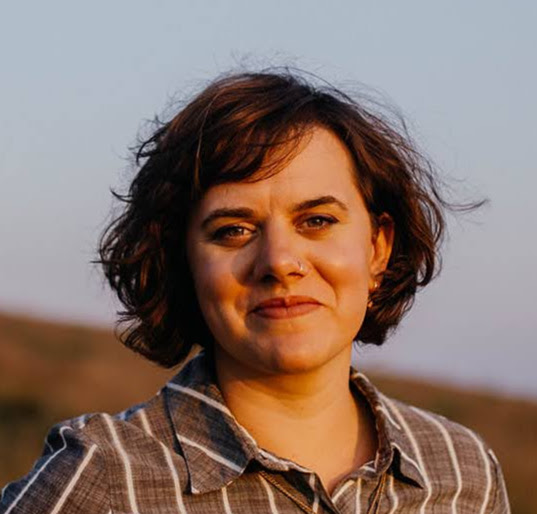
In my interview with poet Molly Bolton, I learned how poetry goes hand in hand with relationships and experiences. Bolton’s vulnerability in her writing draws me into her words, which she finds necessary “to have emotional truth.” From discussing her queer and spiritual influences like Sufjan Stevens and Mary Oliver to sharing her experience writing her personal poetry on the Helene floods, Molly Bolton provides profound insight throughout her interview. I really thank her for her time.
Molly Bolton is a spiritual director, sex ed. facilitator, and liturgist in Foscoe, North Carolina. She is the author of What Blooms in the Dark (Toad Hall Editions 2024), selected by Marie Howe as the Poets Corner chapbook contest winner. Molly’s writing appears in Salvation South, Susurrus Magazine, and Tupelo Quarterly where she received the 2025 Poetry Prize.
What led you to start writing poetry? Were there any major influences in your life?
My high school English teacher pulled me aside and told me to keep writing. That made me pay attention. Learning about the craft of writing—there are actual techniques to employ to get a point, an emotion across—was a revelation.
When I was eighteen, I remember sitting on a rock reading a Mary Oliver poem. And the vibrancy of her words felt sacred to me in the way the Bible never had. Oliver was giving me permission not to be good, which this youth group kid loved.
Molly Bolton
Mary Oliver, Lucille Clifton, Wendell Berry, and Marie Howe were my early influences—I admire their accessibility and spirituality; the clear stake that they have in loving the world. They gave language and imagery for my longings.
As a teenager, I also would listen to Sufjan Stevens with his lyrics in front of me—little did I know that he and Mary Oliver were my intro to queer art & philosophy!
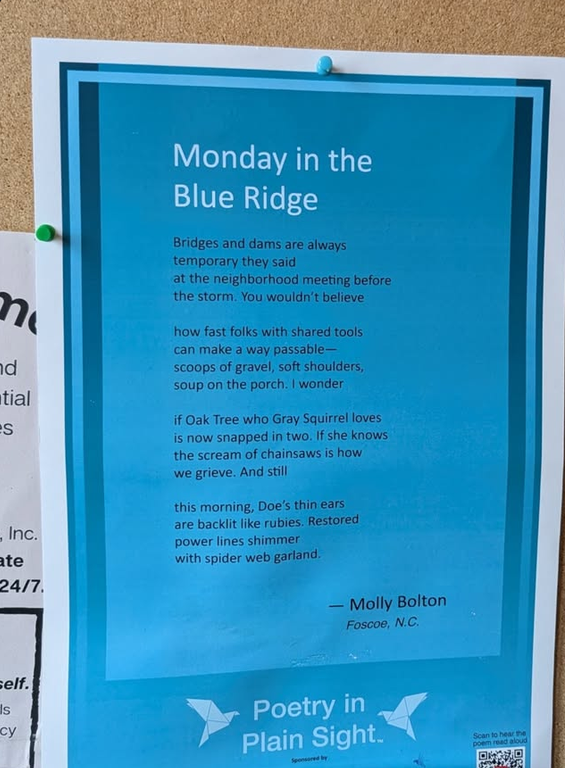
Your Poetry in Plain Sight (PIPS) poem is called “Monday in the Blue Ridge.” As you refer to the Blue Ridge Mountains, are your poems often impacted by nature and your landscape?
When I lived in the city, I tried to know the names of my neighbors—Allie, Bret, and Scotland. And here, in the mountains, I try to know the names of my neighbors too—Jewelweed, Eastern Screech Owl, Ghost Pipe. My child and I greet the crows when we hear them in the mornings. We know that they know who we are. “Hi crows! It’s Mom and Cory!” he says.
Annie Dillard wrote “How we spend our days is, of course, how we spend our lives.” I am fortunate to have my days spent in creeks, collecting acorns, with parents and little kids, with poets. When I put my pen to my journal, my Blue Ridge beloveds flow out.
You’re the author of the poetry book What Blooms in the Dark. What was your writing process for this collection?
After the preterm birth and loss of my twins, poems bubbled from my well of grief. Later, they were mined from my 2AM sorrow-scribbles. I wrote to make something solid of the absence where babies were supposed to be. When I had a stack of poems, my writing friends and companions told me I had a collection. They helped me order the work and select a title. I have deep gratitude for their company in my sorrow, which led to a chapbook that offered healing to me & hopefully to others.
In what ways does your work as a spiritual director affect your writing and poetry? Or vice versa?
Spiritual direction and poetry writing are about the practice of presence and attention. They both ask for connection to the breath; to settle into the body’s wisdom—the heartbeat of a line, the pause before someone says something vulnerable. They are both relational—wisdom stirring from our reverent presence to a person, a place, a more-than-human, a feeling, our own shimmering inherent holiness.
Your work has appeared in several magazines including Whale Road Review and Hippocampus. Do you have advice you would give to poets that are starting to submit to publications?
What poet said that we are writing for each other? Meaning, our art lasts for a mere breath in the scope of humanity. So when I write a poem and then I read it to a friend or at a poetry open mic night, and they receive it, then I consider my poem to have completed its work. We are writing for each other.
With that in mind, I am not so precious about how/where/when I submit things. I just think of it as an offering. So when I am submitting work, I think about: What publications do I have a shared sensibility with? What work will my poems be in conversation with? To whom do my poems want to speak? If it’s just one person, then—what a gift!
You were the winner of the 2025 TQ36 Poetry Prize, which Maya Popa’s judge citation spotlighted your poetry’s “vulnerability and empathy.” Why do you find it important to become vulnerable when writing?
If writing does not have emotional risk in it—what’s the point?? But also, part of learning about the craft of poetry is learning the difference between journal entries and poetry. I want my poems to have emotional truth even if the details of the poem are fiction.
Darlene Montonaro is a writing teacher in Cleveland, Ohio. She taught me about the discipline of freewriting—turning the editing brain off, moving my hand without stopping, and writing from the gut. This practice offers me “clay” from which to make poems. I have to write my way into vulnerability. I have to write my way into surprising myself.
Your poem “somehow bloodroot” is featured in the anthology Had I a Dove. The focus of this anthology was “Appalachian Poets on the Helene Flood.” Do you find it necessary to be a voice for local or global events?
I don’t know if I would have been ready to write a poem about Helene had Hilda Downer not asked me. Because I respect her, I took the invitation seriously. I wrote the poem I was able to write in that state of grief. The poems I write about Helene are different now, two years after.
I find it necessary to feel what I have a sense of invitation to write about. In that case, Hilda offered me a direct invitation. But I also feel an invitation to write about my lived experiences—chaplaincy, pregnancy loss, Appalachia, parenting a young child, teaching sex ed, being what I call a “youth group drop-out.” And if I take those invitations seriously, they are political by nature.
Molly Bolton
In a similar line, do you have any advice you would give to future poets submitting their poems to the PIPS program?
Study the short poems that you admire! For me, that’s Richard Wright’s book of haiku.
Write the stories that are yours to tell. Speak the visions that move you. Ask the questions that are living in you.
I’m curious about which poets you’re currently reading and inspired by.
I know he’s a favorite North Carolina poet and that’s for good reason—I love reading Tyree Daye! The music, syntax, and spiritual tenor of his poems move me so much! His work also invites me to experiment more with form.
In my bag, at this moment, I have the newest Southern Poetry Review, which has been a delight to read. And I have A Literary Field Guide to Northern Appalachia, editors Todd Davis and Noah Davis, which is one of my all-time favorites.
Some of my other favorite poets: Adrianne Lenker from the band Big Thief, Dan from poetry open mic night at Kovu’s Coffee (maybe this will get him to publish some of his work!), and Ann Teplick, who is a Seattle-based poet in my writing cohort.
What are your prospective plans in poetry? Are there any poetry works or events we should know about?
If you are in the High Country, I facilitate a grief group that meets at High Country UCC in Vilas the first Wednesday of each month at 7pm.
I am working on a full-length collection of poems!