
by Abbigail Goetze-Thompson
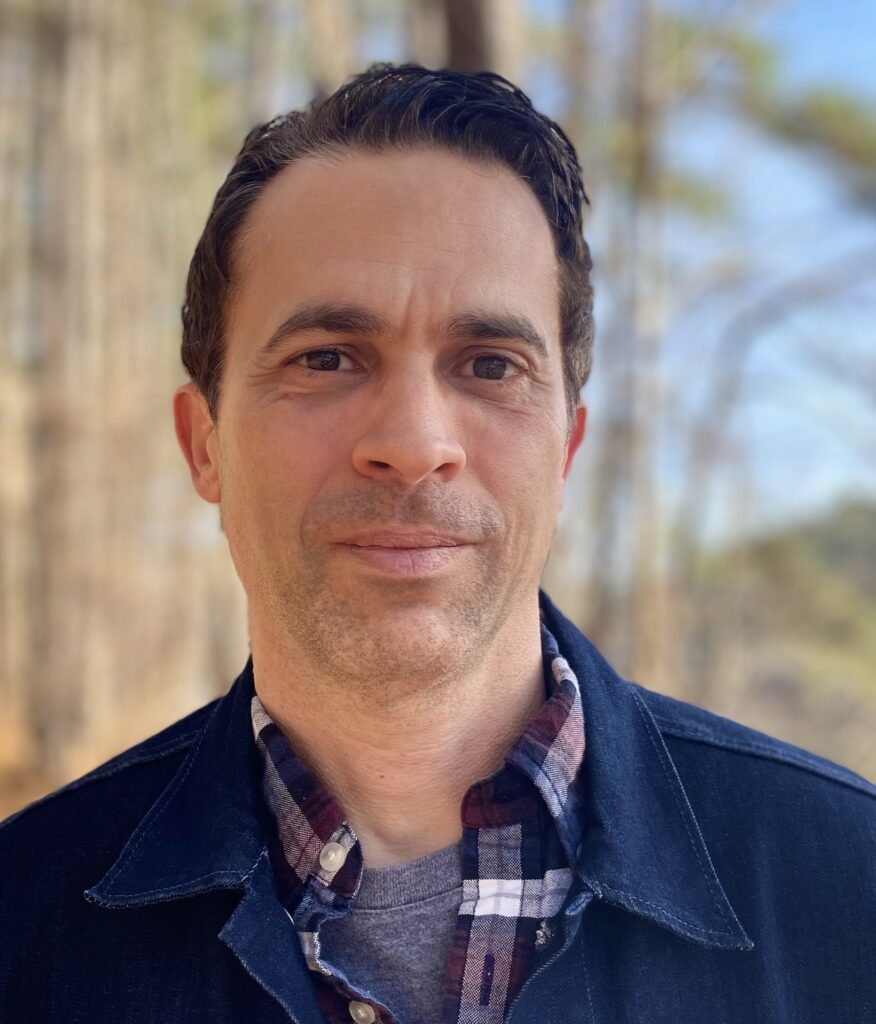
Chris Abbate’s poems have appeared or are forthcoming in numerous journals including The Threepenny Review, Connecticut River Review, and Cider Press Review. He has been published multiple times in Pinesong and Kakalak and has had poems accepted seven times for Poetry in Plain Sight. He is the PIPS site coordinator for Apex and enjoys making monthly poetry deliveries to different venues around town and establishing relationships with the hosts. He has published two collections of poetry, Talk About God (Main Street Rag, 2017) and Words for Flying (FutureCycle Press, 2022). Visit him at chrisabbate.com.
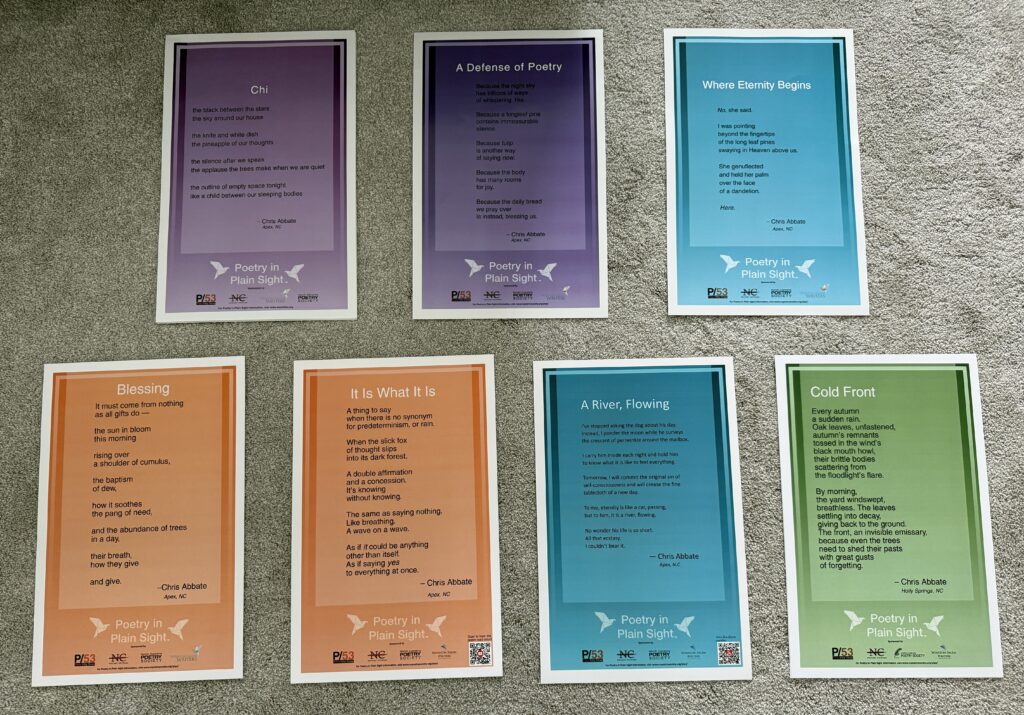
In your poem “Cold Front,” you utilize naturalistic elements in order to get your point across. Why is that?
I think nature is a perfect metaphor for our experience of life, how it is always in flux, how there are both expected and unexpected changes, and how, whether we know it, we are living according to its rhythm. Nature is an accurate reflection of the phases of our lives too, how there is a time for abundance and accumulation and a time for shedding and for releasing, similar to my Poetry in Plain Sight poem, “Cold Front.” There is a time not just for change, but for accepting and welcoming change as part of the natural flow of life, what I refer to in the poem as a “great gust of forgetting.”
In multiple PIPS poems, you reference the longleaf pines. What significance do they hold to you, if any?
I had to look back on my other PIPS poems and you’re right, I mention trees in many of them, and long leaf pines in particular. I hadn’t seen a long leaf pine until I moved to Raleigh from Massachusetts and I was struck by how tall they were, how they seemed to soar and sway in the wind on such narrow trunks. It’s the combination of their majesty and grace that’s so interesting to me, their silent sovereignty. In one of my PIPS poems, I consider them a blessing for the oxygen they give us. And then there is their root system, a consciousness we can’t see, how the roots of trees communicate and feed each other. We are surrounded by trees and writing about them helps me to slow down and appreciate how complex and beautiful they are. I am always trying to come up with new ways to describe trees, but I find it impossible to pinpoint. I suppose that’s what poetry is for, to get as close as possible to the essence of something without completely capturing or objectifying it.
In your poem, “Ox Yoke Yokels,” who is Mr. B? What does he mean to you?
Mr. B lived across the street from me. He was married and had four children. He came across as a tougher guy, a stern guy who was a Marine and had served in the Korean War. I was around seven years old when he got the neighborhood kids together and started a club he called the Ox Yoke Yokels, named after our street. Although the club was short-lived, Mr. B left an impression on me on the importance of bringing the neighborhood kids together in a more formal way. He understood the significance of bonds, and I think organizing that club was his way of passing that along to us. When I was a little older, Mr. B was one of my customers on my paper route. He was an early-riser and, since I lived right across the street, he expected to have his paper every morning by five thirty, no excuses. That kind of expectation instilled a sense of discipline in me to do my job well, no matter what job it was. As a boy, having different male figures to look up to was very important to my development, and it is something I tried to put into practice as a long-time volunteer coach for First Tee, a program that teaches life skills to young people through golf. I hope the men who are reading this can find ways to be a good role model for young people and have a direct impact on their development. Mr. B was just one of those men in my life.
For your book, Talk About God, you place an emphasis on your religious background. Why do you choose to reflect on your life experiences through this lens?
You have researched me well! I was ensconced, or as I like to say, swimming in religion growing up, coming from a devout Catholic and Evangelical family. It was an unusual combination! I went to Catholic school through high school and then went to a Christian college, so I was taking a religion class or was attending some type of religious service just about every day of my life. When I started studying English literature in college and graduate school and then began writing poetry soon after, I was compelled to peel back the covers of it, to understand Christianity on a less dogmatic, more emotional level. My goal wasn’t to sit on a throne of intellectualism and disparage or dissect it, but to understand the deeper truths behind it, what I had witnessed in the adults around me and how it was such a source of peace and joy for them. I wanted to understand the meaning behind all the metaphors, which I had been taught to take literally. I realized that by trying to possess the “right” beliefs, I was depriving myself of seeing the bigger picture, of having a more meaningful connection to what it all was pointing to. By wrestling with my religious upbringing through poetry, I have been able to reconcile many of the conflicting thoughts I carried around. It didn’t take me away from these teachings, but quite the contrary, it brought me closer to the source of them. I came to a clearer understanding of what I was taught, and I’ve worked very hard to sublimate that in those poems.
What has your experience with Poetry in Plain Sight been? What does it mean to you?
Having had seven poems now accepted by PIPS has been incredibly fulfilling. It is one of the things about my writing life that I am most proud of. I think it’s because of the democratic nature of PIPS, how poetry isn’t just something we do in solitude, or in small groups or readings, but is something we do out in the open, in public, a metaphorical language all of us speak in between the activities of the day. Poetry is the subtext of our lives, it is one of the things we cling to for understanding and meaning. I have heard people say how they “don’t get poetry,” but I would argue that music is poetry. If you were to read the liner notes of a song, it is lineated, it most likely rhymes and uses metaphors, along with other poetic devices. But, I understand, I have also struggled reading certain types of poetry, which can be off-putting. That’s why I craft my poems, especially the poems I submit to PIPS, in language and in a format that is both readable and relatable. At the end of the day, I am writing for an anonymous reader and my job as a poet is to express myself as clearly as possible and give them a direct path to understand and connect with that poem.
Why do many of your poems have grim undertones? What is the motivation for making strikingly sad pieces?
What an interesting observation! The poet Robert Graves is believed to have quoted, “All true poems are about love, death, or the changing of the seasons.” So, I suppose there is a grim undertone in most poetry simply because it attempts to capture something temporal. When I went back and read through the poems in my latest collection, “Words for Flying,” I noticed a grim theme in many of them, especially those at the beginning of the book. I did this intentionally because I wanted to jostle the reader out of the gate. However, I never want to leave the reader at the end of the poem in a negative or hopeless state. My goal in every poem is to elevate my thoughts or elevate the object I am writing about into a place of redemption. I also want to uplift the reader and leave them feeling refreshed and mindful. They are giving their time to read a poem I wrote, so I want to be respectful of that and make sure I am closing the circle of my thought, guiding them through the circuitry of a poem and leaving them off in a higher state of heart and mind.
How did choosing to study English in college lead you to start writing poetry?
First off, I was the most unlikely English major. Before going to college, I didn’t read very much and I never read poetry! I was mostly interested in sports, both playing them and watching them. However, I couldn’t imagine studying anything but English in college. Any other major seemed like work, whereas English was interesting, it was subjective and it was romantic. It brought out my passion for life and in so many ways, it spoke to my sense of wonder. I tear up as a write this because that is how meaningful and transformative studying English was to me. I’ve taken only one class on writing poetry, which was my junior year of college, and I didn’t take writing more seriously until my thirties and forties. It was during that in-between time that I completed my master’s degree in English and started my career as a computer programmer for clinical trials. I was reading and listening to poetry and attending poetry readings and open mics. It was a long gestation period. I think I needed that time to appreciate how the more accomplished poets went about writing. I also needed to find my voice, how my poems sound, their tone, which took many years of reading, listening, and writing. I also needed to connect with other poets by leading and attending critique groups. I was in no rush to be a poet; I knew that writing the poems I wanted to write was going to be hard but would be worth the investment.
What has been the highlight of your career?
There have been many highlights over the years. Doing this interview is a highlight, really any opportunity to talk about poetry with a wider audience who would be interested in my thoughts and experiences as a poet. Finishing a poem and having it ready to publish is a highlight. Having a thought and the germination process of starting a new poem is a highlight, knowing that whatever comes out will be something new and unexpected. Connecting with other local poets in NCPS and feeling their incredible support has been a highlight, realizing that poetry is shared and shouldn’t only be done in solitude. Being a PIPS poet, publishing two books and finishing the manuscript for a third, reading at bookstores across the state, publishing in many different journals, taking family and friends along with me on the journey, have been highlights. Trying to see the things of ordinary life on a deeper level that poetry allows us to do, the mindfulness and contentment it brings, has been a highlight. Finally, one highlight that stands out to me is the encouragement a featured poet gave to me many years ago when she heard me read at an open mic after her reading. “You have something good there,” she said. “Keep it up.” Just that simple comment that propelled me to continue writing. I have never forgotten that.