
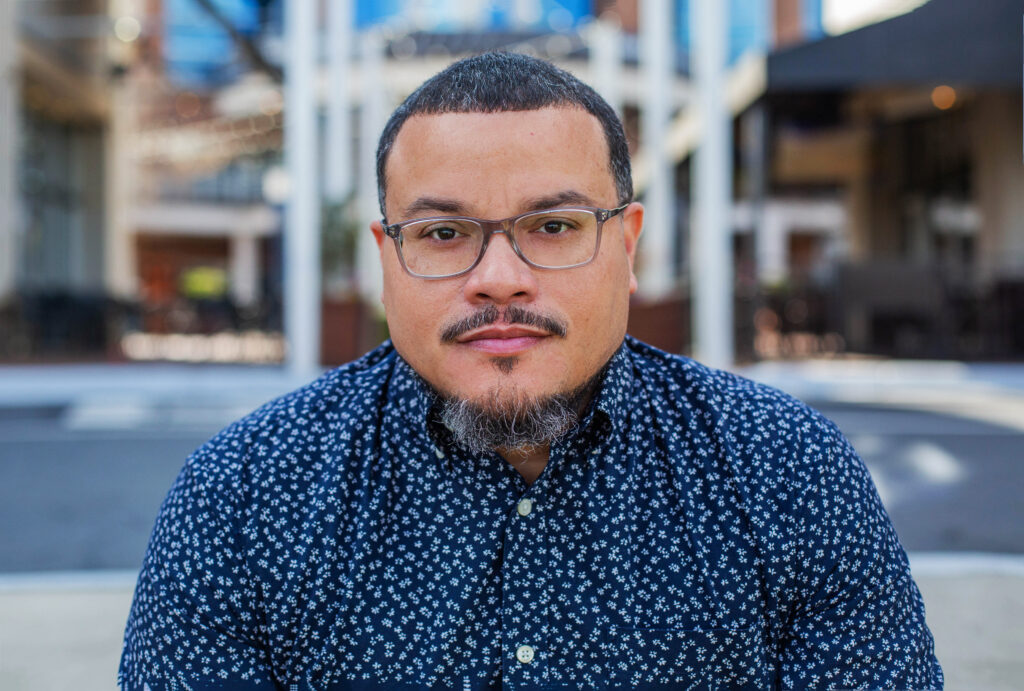
A thoughtful conversation with Charlotte’s inaugural poet laureate and spoken word artist, J. Ward
By Jackie Knowlton
Junious ‘Jay’ Ward is an Emmy nominated poet and teaching artist living in Charlotte, NC. He is a National Slam champion (2018), an Individual World Poetry Slam champion (2019), author of Sing Me A Lesser Wound (Bull City Press 2020) and Composition (Button Poetry 2023). Jay currently serves as Charlotte’s inaugural Poet Laureate and is a 2023 Academy of American Poets Laureate Fellow, a 2026 recipient of the Mary Frances Hobson Prize, and current Writer in Residence for Charlotte Lit. Ward has attended Breadloaf Writers Conference, Callaloo, The Watering Hole and Tin House Winter Workshop. His work can be found in Columbia Journal, Four Way Review, DIAGRAM, Diode Poetry Journal and elsewhere.
Social Media: (FB: Jay Ward, IG: charlotte_poet, IG: jward2030) Website: jwardpoetry.com
In this interview, J. Ward discusses how he entered the spoken word space after moving to Charlotte and gives insight into the skills he utilizes during performances. He discusses craft elements, including writing a strong opening, maintaining a distinct point of view throughout a poem, and balancing various thematic elements. He talks about the impact that poetry has on members of a community, as it gives, “language for things they never knew how to talk about.”
Thank you so much for this insightful conversation!
I have noticed that some of your poems, including “Flowers as Honesty” and “The Field White for Harvest but the Neighbors Saw Nothing”, utilize a different structure than many of your other poems in the way that sections are broken up. What inspired you to make this choice, and how do you know when a poem will be most effective with a certain structure?
Both “Flowers as Honesty” and “The Field White for Harvest but the Neighbors Saw Nothing” are contrapuntals, meaning the vertical columns can be read as separate poems, but if you read the lines horizontally they create an additional poem. I’ve been a little obsessed with the form since reading Olio by Tyehimba Jess, so the original draft of “Flowers as Honesty” was a contrapuntal that I kept working on until it felt ready. However, “The Field White for Harvest…” originally began as a performance piece, and then underwent several iterations before becoming a contrapuntal. During the time of revising that piece I was intentionally studying form and had revised an entire manuscript of poems into and out of specific forms, trying to determine how each poem benefited (or suffered) from being molded into specific containers.
My thinking with “The Field White for Harvest…” was to create multiple points of view, multiple ways to tell or receive the story, to mimic what was happening in real life between testimony, media coverage, and plain facts in the case being referenced. In fact, there are many variations of how that poem can be read, and although I think the story that is revealed feels pretty straightforward (to me), I also think the way the reader is forced to receive this poem implants within them some suspense (and maybe anger?)
As a teaching artist with Charlotte Lit, what is the most rewarding part of coaching aspiring poets?
Most of the time that I’m teaching or coaching, I’m trying to offer things I’ve learned that have been helpful to me along the way. Sometimes, I’m sharing in-progress thoughts that I’m still working out for myself and I get to figure them out in real time with the thoughts of other writers in the room. In both cases there’s a sense of communal learning that I also benefit from and really enjoy.
Reading a poem line-by-line with a poet and having a shared “aha moment” where we both realize where the poem is working its best, or perhaps not working, feels like a sort of magic.
What piece of advice do you give most often when you are coaching?
I think in general, “read, read, read” is probably the most common, stereotypical, cliché (and overwhelmingly necessary) advice I’ve given or received. Given that you can also receive poetry as performance art, visual art, and in an audio book format, I’d update this mantra to “consume, consume, consume.” There’s so many reasons why this is true, but I’ll simply say the more we consume the more we produce.
Outside of that I do ask poets about the reason for certain lines, or what the reader is supposed to get from certain lines. And when the answer is something really moving and profound, which it often is, I ask “where is that in the poem?” I’m really asking “is there enough information in this poem? Is there too much?” This is a question I think we all have to ask ourselves as part of the revision process.
Your slam poetry performances are very impactful for audience members, and I can see this in the ways that I hear audience reactions throughout the performances. What strategies do you have for giving a reading, and how has your approach shifted over time? Have you always felt comfortable connecting with an audience, or did this take experience to achieve?
Thank you very much!
My strategy for a reading is to craft an experience. I have in mind how I want the audience to feel at the beginning, end, and middle of my set, and I try to select poems that will help me do that. This is also true of each individual poem, I’m trying to create an experience, I’m tapping into the emotion and maybe logic of the poem and figuring out how to use that to connect with the audience. I think of it this way; when I’m revising the poem, I’m telling the words what to do. When I’m reading or performing the poem, I’m letting the words tell me what to do.
Jay Ward
Time and experience definitely played a role in getting comfortable connecting with audiences, I’m an introvert by nature and socially awkward even on my best day. Early on I realized something significant about myself. I’m not always comfortable in social settings because I have no control over how those will go, I’m not always sure what to say, I’m not always confident in my conversation skills. However, when I’m giving a reading or performing, I’m kind of in control of most of that conversation. So I prepare. I prepare for multiple possibilities (which is another conversation altogether, lol), I prepare a delivery that feels conversational. That level of preparation actually frees my brain to have the capacity, but not necessarily the obligation, of impromptu banter within the set that I’ve prepared.
What did it mean for you to be selected as Charlotte’s inaugural Poet Laureate? What legacy do you want to leave for this position?
It definitely validated the work I was already doing to that point, but also reminded me that other poets were doing good work in the city as well. It reminded me that there’s so much room here for our poets to really impact the community. And, maybe more than anything, reminded me that sometimes there are projects we want to embark on but we stop ourselves because we don’t have the “title.” One thing I’ve learned is that no one else is thinking about the title, it’s just us—but often we can do the work without the title. With the title, we tend to give ourselves greater permission to act. But really, we can give ourselves the permission now. We can do the work now.
I want to leave a legacy of “what if.” What if we do this thing that’s never been done? What if we give tools to folks so they can do it themselves? What if we take poetry into places it hasn’t been before? What if instead of doing the same work that this other group is doing, we ask them how we can help them with their work, or maybe work together to create something altogether new?
Jay Ward
When did you first become interested in poetry, and what inspired you to become involved in the poetry community?
My interest in poetry began in 5th grade, mostly prompted by English teacher Ms. Tudors. She would read to us and let us take turns reading to each other. She would teach us about Langston Hughes. I should also say here that Hip Hop music, which was young at the time, had a role in pulling me into the sonic nature of words and the ability of language to really impact people.
It wasn’t until I moved to Charlotte in my early 30’s that I really tapped into the poetry community. I ran into the city’s heavyweights (Bluz, Dani Cook, Jaycee, CP Maze, and etc.) and decided I would go to the legendary Wine Up. My initial goal was to learn more about performing and presenting my work, since I was not really performing my poems at that time, but I ended up learning so much more about writing than I had dreamed.
The spoken word community cultivated within me the desire for community, for teaching, for impacting lives. Prior to that I was just writing, and sometimes presenting poems. Their example showed me how and why I needed to create impact beyond the page.
Your poems have very strong hooks that immediately pull me in. What is your process for opening a poem?
That’s very kind. I try to give a lot of consideration to how a poem opens and I think part of the process for me is to know that my draft isn’t perfect. I know that sounds like a simple truth, but knowing that a better version of the poem can exist gives me permission to change things around. I might write a draft of a poem that feels really good to me, but then I realize that the actual opening line of the poem might be in the middle somewhere. Then I have to ask myself whether I really needed all that other stuff that came before it…and a lot of the times the answer is no.
The other pitfall with honoring a first draft too much lies in the belief that you can edit as you write it. When you edit as you write a draft, you’re already making pivotal decisions about the poem and where you want it to go. One of those decisions is how the poem should start.
For me, I really have no idea where the poem is going to go or how it should start, not while I’m writing it anyway. But somewhere along the way, the poem starts getting into a rhythm. It might be that the beginning of that draft was just the poem getting into a rhythm. If that’s true, can you get rid of (or repurpose) what you thought was the opening of the poem, and instead just jump right in?
Your poetry chapbook’s title Sing Me a Lesser Wound is nodded towards in the poem “Homecoming, Rich Square, NC” in the lines, “how thorny it feels, how it calls/out blood like the Big Dipper sang/a whole bloodline toward a lesser wound.” Can you give insight into your decision to discuss singing closely to pain?
One of the things I’m most proud of is the title of that chapbook, which came about because of a conversation I was having with Ross White while we were trying to pick a better title. I can’t remember what the original title was going to be, which is an indicator of how bland it probably was.
In the poem, I was first drawing a parallel between how the thorn pricks the skin and calls the blood to come out and how the North Star called slaves in the Underground Railroad to freedom. The singing reference seemed to come naturally, and was an allusion to the negro spiritual “Follow the Drinking Gourd,” which was, of course, the Big Dipper/North Star. There is much that can be said here about how Negro Spirituals (and the Blues and Hymns and etc) can use pain as a way of release. I was hoping to capture that in that line.
Jay Ward
In what ways has performing your poetry allowed you to feel more connected to your community? Was there anything that surprised you about this experience?
When you write a poem, you could, in theory, process it and forget it. If you choose to read that poem in front of an audience, you feel a greater sense of connection. When you perform that poem, you must first embody it, you must learn it over and over, and you must learn from it over and over. Performing my poems has taught me so much about myself and about my audiences.
You write a lot about your personal experiences with your family, yet it feels universal and relatable to many readers. What challenges come with writing about personal experiences, and how do you achieve this level of authenticity?
There is the challenge of memory–it is fallible and malleable. There is also the challenge of not wanting to put other folks’ business out in the streets. There is also the challenge of not wanting to tell other folks’ stories for them, they have their own voice after all. The way I look at these challenges is to focus as inward as possible. Yes, so and so was involved. Yes, the event happened at so and so’s house. But how did I feel, what did I do right, what did I do wrong, did I grow from it, how was I changed? I’m not saying so and so should not be mentioned by the way, I think there are other questions that govern naming names, I’m just saying the reader is connected to me first, and I want to honor that connection. In many ways I’m still learning how to be more vulnerable and authentic while navigating these challenges.
Can you talk about the ways in which a vibrant poetry scene benefits the entire community?
This is a really important question. The poets are out there making change on a person to person level. I mean to say that at any particular poetry event a poem that seemingly goes unnoticed or underappreciated, really resonated with one person in the audience. Another audience member really resonated with a different poem altogether.
A vibrant scene means poetry is touching a myriad of different people in different ways in different venues. It means the day after the event, a project manager, a sales clerk, a teacher, a janitor, all go into work with a better perspective, a new worldview, a greater tolerance, or a fundamentally altered understanding of a family member. A vibrant poetry scene is gifting language to the entire community. And once a community has language for things they never knew how to talk about…there is change.
What is next for you? Where can we watch you perform, and how can we support your work?
I’m currently working on a collection that is a hybrid of poetry, lyric essay, speculative fiction, and screenplay. I have no idea where it’s going or what final form it will take, lol, which is both scary and exciting. If I’m lucky, I’ll finish it in 2027 and, depending on what genre(s) it eventually falls into, shop it around for 2028.
Most of my performances these days are via workshops, speaking engagements, and school visits but if you stay tuned on Social Media (FB: Jay Ward, IG: charlotte_poet, IG: jward2030) I try my best to post performances and upcoming events.