
An in-depth conversation with former Gilbert-Chappell Distinguished Poet and current Professor of Creative Writing and Literature at East Carolina University
by Maya Thomas
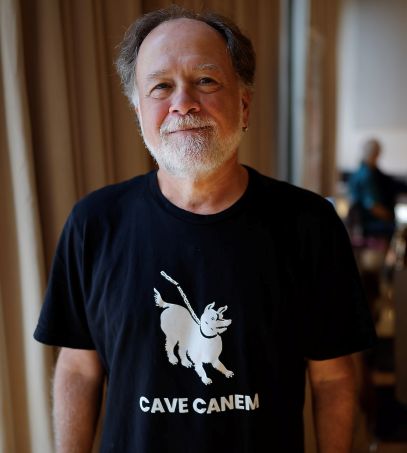
John Hoppenthaler’s books of poetry are Night Wing Over Metropolitan Area, Domestic Garden, Anticipate the Coming Reservoir, and Lives of Water, all with Carnegie Mellon UP. With Kazim Ali, he has co-edited a volume of essays on the poetry of Jean Valentine, This-World Company (U of Michigan P).
He served as Personal Assistant to Nobel Prize-winning writer Toni Morrison from December 1997-August 2006. His poetry has been praised by award-winning authors that include former US Poet Laureate Natasha Trethewey, MacArthur Genius Award recipient Campbell McGrath, Grammy Award-winning singer-songwriter Rosanne Cash, and American Book Award winner Li-Young Lee, as well as by Dorianne Laux, David St. John, David Baker, Brian Turner, and Michael Waters.
He was the editor of A Poetry Congeries for ten years and the Poetry Editor of Kestrel for twelve years. He lives in Raleigh, NC, with his wife Christy, his stepson, Danny, and Pablo the dog.
You can connect with John and view his most recent and upcoming events at the following links: Facebook, Instagram, Bluesky, ECU English Department
John Hoppenthaler’s Journey
In my interview with John Hoppenthaler, he discusses his journey to becoming a poet and his early inspirations. Hoppenthaler spent years as Toni Morrison’s personal assistant, served as a Gilbert Chappell Distinguished Poet, and currently teaches Creative Writing and Literature at East Carolina University (ECU). His work is influenced by landscape, relationships, and his approach to realism. He emphasizes the importance of artist colonies and mentions his fifth return as poet-in-residence at the Chautauqua Institution. Through his vast experience in poetry, he provides valuable advice throughout the interview, and I especially enjoyed his advice of “talk less and listen more, and afterwards, take what you need and leave the rest,” when dealing with criticism or feedback, and I’m extremely grateful for his in-depth answers.
Congratulations on being a Poetry in Plain Sight Poet!
- When did you first become interested in writing poetry?
Thank you, Maya. I came to poetry relatively late, after messing up a lot as an undergraduate and finding myself a night shift custodian at the high school I graduated from and taking classes at the local community college in one last effort to get a college education. I was always poor at math, so I gravitated toward English and Social Studies, but poetry wasn’t a thing in our home. I’m first gen, and my parents both immigrated separately from Romania when the Communists took over the country. Although they were Romanian by birth, their heritage was largely German and Hungarian. Anyway, I was going through course offerings for English classes and came upon a poetry workshop and a lit class in Contemporary American poetry. Before too long I was hooked, and as I’ve stated elsewhere, I truly believe that finding poetry saved my life.
- In your poem, “And Also, the Floods,” you mention Eureka Springs. How has setting affected your poetry?
Setting affects my poetry profoundly since my poems tend to begin in the landscape I happen to occupy when the chance to sit and write a draft. The poems of my first book, Lives of Water, were largely written during the years I served as Toni Morrison’s Personal Assistant. That was back home in Rockland County, NY, located in the lower Hudson Valley region. I grew up spending a lot of my childhood roaming the woods of the area, and there is so much water there: streams, brooks, ponds, lakes, and, of course, the mighty Hudson rolling by. Toni’s home was on the bank of the Hudson. You can see, on the other side–the Westchester side–Washington Irving’s home, Sunnyside, and, of course, Sleepy Hollow is near there, too. There is a particular quality of light along the river that is often alluded to when people discuss how it’s captured in the paintings of the Hudson River School artists. One day I saw a full rainbow stretch over the river and Tappan Zee Bridge, one side to the other. And there was also a lot of wildlife everywhere, and I did a lot of fishing, so that landscape very much informs the first two books. Many poems were written on Toni’s dock.
Of course, that’s changed since I no longer live there, but another thing that has changed is that I got married late in life, days before I turned fifty, so a long-time bachelor was suddenly thrust into the very new structure and responsibilities of marriage and step-fatherhood, and that collided with a life of being able to write whenever I wanted, for as long as I wanted, with nothing much to intrude on that time. The question became, how do I make space now for this passion that saved my life. Where do I find the solitude and quiet I seem to require to write poems? The answer has become artist colonies. I also have a great childhood friend who owned a summer home on Lake Anna in Virginia, and he allowed me to use it on spring breaks and whatnot, and I even spent a week camping by myself at the Outer Banks in a State Park one year. I have had several residencies at the Weymouth Center, a couple at the Virginia Center for the Creative Arts, one at the MacDowell Colony, and, as you mention, also two at the Dairy Hollow Writer’s Colony in Eureka Springs.
- What can you tell me about your connection to Arkansas?
The only connection I have to Arkansas–beside my deep appreciation of Lucinda Williams’ songs and the fact that my first poetry teacher, Dan Masterson, was published by the University Press of Arkansas and Lucinda’s dad, Miller, was Dan’s editor–is that the wife and best friend of a very dear friend, the late Franklin Johnson, moved to Arkansas after his death. Other family and friends had already ended up there. It was Franklin–a Cordon Bleu-trained Chef–that led me to Toni Morrison. I tended bar for his catering business for a while, and one of his clients was Toni. Anyway, Stephen, who was also Franklin’s sous chef and sommelier, sent me an email with a link to Dairy Hollow, which I’d not heard of, so I had the great opportunity to both get a lot of writing done in a new landscape, but also to spend some time with my old friends and eat a lot of great food.
- You work as an English professor at East Carolina University (ECU). How do you manage the balance between your professional and your creative life?
As I suggested above, I need solitude and quiet and time to write, and there’s not much of that during the academic year. I may revise drafts of poems, but I rarely write any during a typical week. But there are perks beyond a dependable salary and health insurance. I do receive some support for travel to conferences, or for readings and other opportunities. As with any academic, there is an expectation to not only publish your work with good presses, but also to present your work in various forums, and for a creative writer, that often means giving readings at other universities, bookstores, and other public spaces. So, I do the best to balance my job, my marriage, and my art.
- You wrote a poetry book titled, Night Wing Over Metropolitan Area. You cover multiple topics and messages, including political concerns. How do you choose current events to incorporate into your poetry or literature?
They just appear organically. We‘re all politicized bodies and what those in elected–or appointed–offices do affects us, for better or worse, and I very much believe that it’s a good writer’s duty to engage with the politics of their time. To do other is escapism, and I tend to be a realist. Art should do work, and part of that work is to respond to what is happening around us. That’s a cornerstone of freedom, and it’s under attack even as we speak.
- Another poem from your poetry book is “Bourbon, Cigarettes, Van Morrison.” You write how music, such as Van Morrison’s, influences aspects of your life and your emotional state. What is another example of a piece of music or an artist that has moved you deeply?
Well, as far as music that actually plays a role in certain poems: The Grateful Dead; an allusion to Steppenwolf’s “Born to Be Wild” in “Nocturne”; the Gregorian chants that inform “Chant”; a Woody Guthrie lyric, “California Stars,” put to music by Wilco and Billy Bragg; a song by Indigo Girls is alluded to in poem in my first book, “Memphis”; “Buffeted,” in my second book, mentions the Paul Simon song “Hearts & Bones.” Oh, and a poem in my first book, “Silver Wings.” Merle Haggard, Kris Kristofferson, Otis Redding, Patsy Cline, Harry Nilsson, the Chi-Lites, Glen Campbell, and Procol Harum are all in there. So many. There’s also a poem in my second book, “Busking,” that references Van again, as well as The Rolling Stones, the Beach Boys, and Barry Manilow. Music is incredibly important to me. There are folks I haven’t referenced in poems that have been hugely influential to me as an artist: Neil Young, certainly, Bob Dylan, Joni Mitchell, Roseanne Cash, Paul Westerberg and the Replacements, the Allman Brothers, Steve Forbert, Bob Marley, Motown, punk, Miles Davis, jazz, funk, hip-hop, it’s all in there.
- You were given a Residency Fellowship to Wildacres Retreat. What projects or works did you work on while you were there? Was there an aspect of the retreat that inspired you to write?
I worked on poems toward my fifth collection, tentatively titled Toward Eureka. It’s a beautiful place, up in the mountains in Little Switzerland, and I holed up in the lovely cabin they provided, sat out on the porch and listened to the birds, watched butterflies flicker about. All good.
- Which poets or writers influence your work or are you interested in?
This is a nearly impossible question to answer because there are so many that have had either quite directly or indirectly had an influence on my poetry. I can begin with the folks who have been kind enough to have blurbed my books: Michael Waters, Natasha Trethewey, David St. John, David Baker, Li-Young Lee, Jim Harms, Dorianne Laux, Anna Journey, Brian Turner, and Campbell McGrath, but there are so many others, some of the generation before me, like Jean Valentine, Lucille Clifton, Maxine Kumin, Galway Kinnell, and too many others to mention, but also some that are younger than me, especially Keetje Kuipers and Geffrey Davis.
- As a past Gilbert-Chappell Distinguished Poet, what advice would you give to future mentees?
Understand that being a writer requires one to endure critique, even criticism. Understand, as well, that you need to be harder on your own work than any book reviewer, or distinguished poet, will ever be. So, talk less and listen more, and afterwards, take what you need and leave the rest. In the end, your poems are yours, and it’s you who will have to take responsibility for them. So, expect courtesy, honesty and support, and learn to break a line like a pro. Each teacher you find on your path will offer one or two things that become a significant part of your growth.
- As an upcoming workshop instructor for the Chautauqua Institution, what excites you the most about this program?
Oh, Chautauqua is an amazing place, rich with history–not only the unfortunate fact that Salman Rushdie was stabbed there. I mean, Amelia Earhart landed her airplane there and gave a talk. Theodore Roosevelt called the Chautauqua movement “the most American thing in America.” There’s music, there are lectures and political discourse, readings, and, if you’re so moved, religious programming. Chautauqua Lake is beautiful. This is my fifth go at being a poet-in-residence there. I’ll lead a poetry workshop and offer a reading with the prose writer-in-residence. Ken Burns will give a talk, and I’m very excited about that, and the editor of Poetry Magazine, Adrian Matejka, will be in conversation about his new book. Can’t wait!
- Lastly, what are your future plans with poetry? Are there any upcoming events or publications you will be a part of?
Well, I plan to finish this next book by the end of the year and then turn toward a New & Selected volume for my sixth book. My first book was published in 2003, and I guess the next would come out 2029 or so, so I am not thinking much past that. I hope to give as many readings as possible. I will read for the South Carolina Poetry Society and offer a workshop in October at their annual meeting in Charleston. As far as publications, I have stuff out at good journals and await their decisions. That, too, is part of the poet’s life.
Thank you so much for your time.
It was my pleasure, Maya.